Patreon

Sunday, November 8, 2020

Updates, playtest, and the Kickstarter Round 2

Quick post today, updates on the game and other stuff that is happening.

Who does Hiro give that flower to? Become a Patron and find out!

First! I've been working on some minor tweaks and updates, streamlining and cleaning up the rules. This is a bit more extensive than the original scope of the tech-edit I'd planned, but as I'm a completely idiot, I am thoroughly playtesting all of these changes as soon as I write them. They're also being made available to patrons, who can click on our shiny patreon button up there and get both those updates and some sexy new art from our rockstar Kazuki Shinta.

Second: We're proceeding at a great pace. The writing had a big leap forward this week, and I'm plowing forward with the remaining content and process rules today. Once those are done, we can finally get to the meaty fun parts of the system, the kung-fu supermoves and other associated badassery.

An accurate depiction of the writing process

Third, I'd like to have the second kickstarter campaign, Round Two, launch in December. Right in time for a very merry Fistmas to all. I've got some groundwork to lay for that, but it starts here, with this declaration. Spread the word; we're delayed, not dead.

HO HO MOTHERFUCKER

Below is a three-hit combo, my writeup of my late-night Denny's-based playtest session and my thoughts on it. This first appeared on our Discord, the Fistoverse. Part one are my musing on the current design and rewrites, part two is a video I recorded this morning after a few hour's sleep post-session, and part three is the written session recap.

This playtest was based on Blood from God's Eye, the Quickstart Adventure which you can download for free (or money if you want to see more art sooner rather than later) and follow along with. 

PART ONE: HOLD YOUR FISTS UNTIL AFTER THE ROLEPLAY

"So! First: It went well. Actually so well that I was surprised

The lone combat (which happened two hours into the session, wowee) was a gigantic setpiece with tanks, armies, and six Degree 1+ heroes

Lasted about two rounds, but they were big and explosive with a ton of action

Takeaways:

1) I have no idea what I was thinking with the new Prana calculations. What, FIVE in the pools? What?

So that needs to get fixed

2) Effortless doesn't work as a core for action. BUT, it works well as the passive defense and the basis for unrolled actions. So that's nice

3) All or nearly all of the way processes and content are being designed works like a motherfucker in play. This pacing was solid

4) I need to probably divide the way Imbalances work; it's fine to have the GM doing rulings and adjudications for player actions (basically expanding their interpretation and veto powers) but it doesn't work for NPCs under their direct control. I should probably just have a set of guidelines for roleplaying and describing injured characters that GMs have to adhere to, because if those are available to players, then you effectively flip that adjudication role and the player is given limited veto over GM descriptions. That feels like a more functional paradigm, will have to work on it

5) Argh failure spiral. Bad guys might never be tough enough to survive an asswhuppin' in round 1 by a table of capable players

And THAT problem might actually be unavoidable so long as NPCs and PCs use the same rules to advance

We'll see if my fixes to mid and high-level Techniques, which gives them expanded free functionality against groups, can turd the tide there and make bosses tough enough to feel right

I also might make it more explicit in the rules that followers can absorb attacks for you, so they can be used to pad out the health of bosses

Even though that feels kind of lame, like Frieze never hid behind his minions. Motherfucker was just a solid wall of asskickin'

"Punch THIS you dirty monkey!"~My hero, the genocidal bishonen alien

Anyway, the players were incredibly engage and had a fantastic time. They basically begged me to run again, and now man I want to because I want the boss battle with Flesh Eating Sage."

PART TWO: PUNCH-DRUNK LOVE


PART THREE: WHY PUNCH ONE TANK WHEN YOU CAN PUNCH TEN

"Okay so the session itself

I took it from where the last playtest left off, which actually makes this a record third consecutive game in a playtest for me

Which is good, because I need to see how the game holds up as it acquires rulings and has to deal with it's own history

Spiteful Prince, our Silver Phoenix, was recovering in Last Hope Fort, having been wounded by Oily Manyu and brought there by Hiro and the surviving Golden Lion soldier from the tank battle at the Battle Zone

Anyway, they were soon joined by Seven Sorrows Raven (player reprising her from an earlier playtest, actually) who was seeking out Hiro (a friend in that game) to help her get revenge on Flesh Eating Sage

Finally, Cave Buffalo, newcomer to the group, came down from the Brotherhood stronghold to ensure that package they're carrying gets delivered to Bao.

Quick sidenote: That player was a dream player for me. Constantly working within the fiction, thinking tactically, roleplaying consistently, just jumped feet first into the game and was a fucking blast the whole time. Every one of my players was radical but that guy, whom I have never roleplayed with before, was just a joy and it was such a blessing to just, luck into a dude like that

So, here's the interesting thing about this session

Next guy to show up, with his army, is Luckless Chuan

And he DEMANDS the package from the party, citing the desperation of his circumstance and the huge consequences if Flesh Eating Sage takes his goldmine (and no joke, they are DIRE)

And... They talked it out. Like not one punch is thrown

Almost pure roleplay, players are engaged, trying to find compromises, figuring out the tactical situation, trying to come up with plans

It was beautiful. And unexpected, my players are usually such hilarious murderhobos

So they investigate the fort, since Buffalo uses his water-charming mantra to sense the presence of old, stagnate water in the pipes around the ancient fort, and he finds a water main leading WAY downward and they figure they can get into his stomping grounds that if they follow it down

They are CORRECT; they actually wind up in tunnels that connect them eventually to the resting place of the ORIGINAL Two-Souls Bao

So they encounter her out of sequence, which I found delightful, and skip the whole "Haha the quest was a TRAP!" twist and they actually NEVER meet the evil clone Bao

Man, Bao got their respect though. She's really high-degree and she just tears through their stealth attempts like tissue paper

Not that she does anything but invite them to her hobo-dinner because like, she's cool if they kill her. She just refuses to die without dignity and calls them out like "Look if you're gonna kill me, just do it. Otherwise it's supper time"

Anyway, they crack open the box, find the note from Hiro's deceased master, and actually get Bao to agree to return with them to Last Hope to defend the Lions against the Vipers. She Refuses the blade, saying it should be in the hands of a worthy hero (as she still considers herself a failure). Hiro winds up with it, since it was his master that sent the blade.

Anyway, they return to the fort, make plans, aaaaand then the tanks start rolling in

A runner arrives and tells them that the Viper's tank armada is on the move through the Battlezone, en route to Luckless Chuan's outpost

Shit gets real quick; they unearth some AT weaponry under Last Hope, but it's ancient and not necessarily safe. I rule that they get 1 shot per rocket (10 total) and they've got a 20% of being duds, with a 10% of catastrophic misfire

They make an actually great plan to hide the newly-arrived Brotherhood of Freaks reserve troopers under the marsh with the missiles, cover them in a thick mist summoned by Seven Sorrow's weather control, and ambush the tanks before they can besiege the mining operation and starve them out and/or demolish everything

Unlucky for them, BOTH Oily Manyu AND Yeman the Elephant-Eater are on those tanks, and Manyu's epic R6 Senses action discovers their hidden forces. He orders his line of five tanks to entrench and shell the area, while Yemen's brigade of 6 Blitzkriegs around

Roll Initiative

Thankfully, Buffalo bids high, grabs initiative and manages to snake out 7 hits with zero misfires (curses!), disabling the back line of tanks and wrecking Yeman's lead charger. Yeman leaps out and Buffalo personally engages the madman, they trade blows and Buffalo's Riptide Defense shield saves him from a near-certain decapitation

Manyu however, eager for a rematch, spots Spiteful Prince hovering above the battlefield and sends both a Glint of Hellish Steel and Summoned Hellish Armament (poisoned chalcedony shadow needle) his way, breaking through his defenses and sending Prince crashing into the mud

No tanks were thrown in the making of this conflict

ALTHOUGH, the previous battle had one punched to death by, who else, Hiro, who had snuck inside it's bombed-out husk and points the main cannon at Manyu's tank, cratering it and sending Manyu face-first into the dirt (and breaking just, so many of his bones and internal organs)

Hiro THEN proceeds to pop out of said tank like a DAISY, calls out Yeman (who's ass they had previous beaten in that fight) and punches him into a bloody pulp, finishing him via decapitation with his shiny new god weapon

The Prince, not to be outdone, summons a psychic shockwave that crushes the tank crews into a pulp Tetsuo-style, and in the next round, Manyu's attempt to escape is cut short by a Prana-devouring beam from Heaven's Tear and his LIFE is cut short by a fusillade of bullets form the machinegun-armed Brotherhood warfighters

Battle over, no enemy survivors"

Wednesday, October 21, 2020

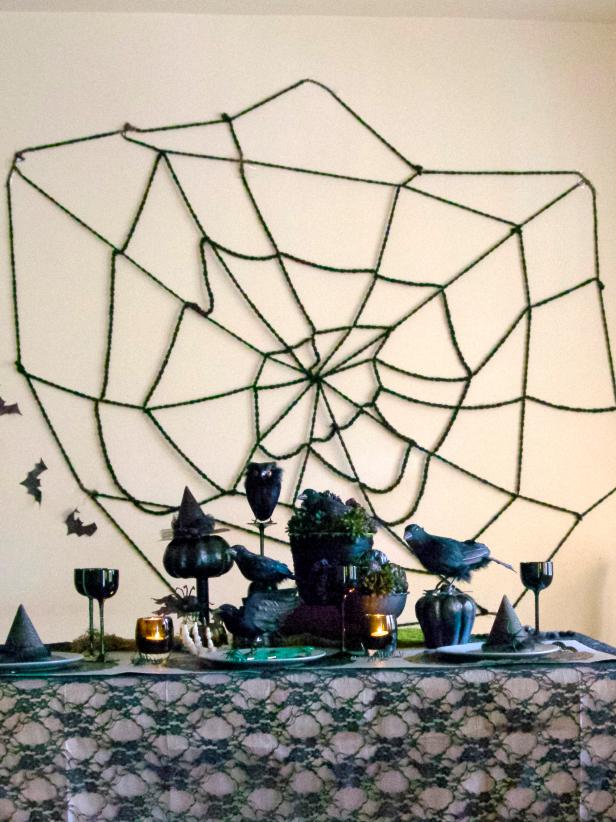
 Lots of cobwebs around here

Loooots of cobwebs.

But hey.... It's Halloween. Cobwebs are appropriate.

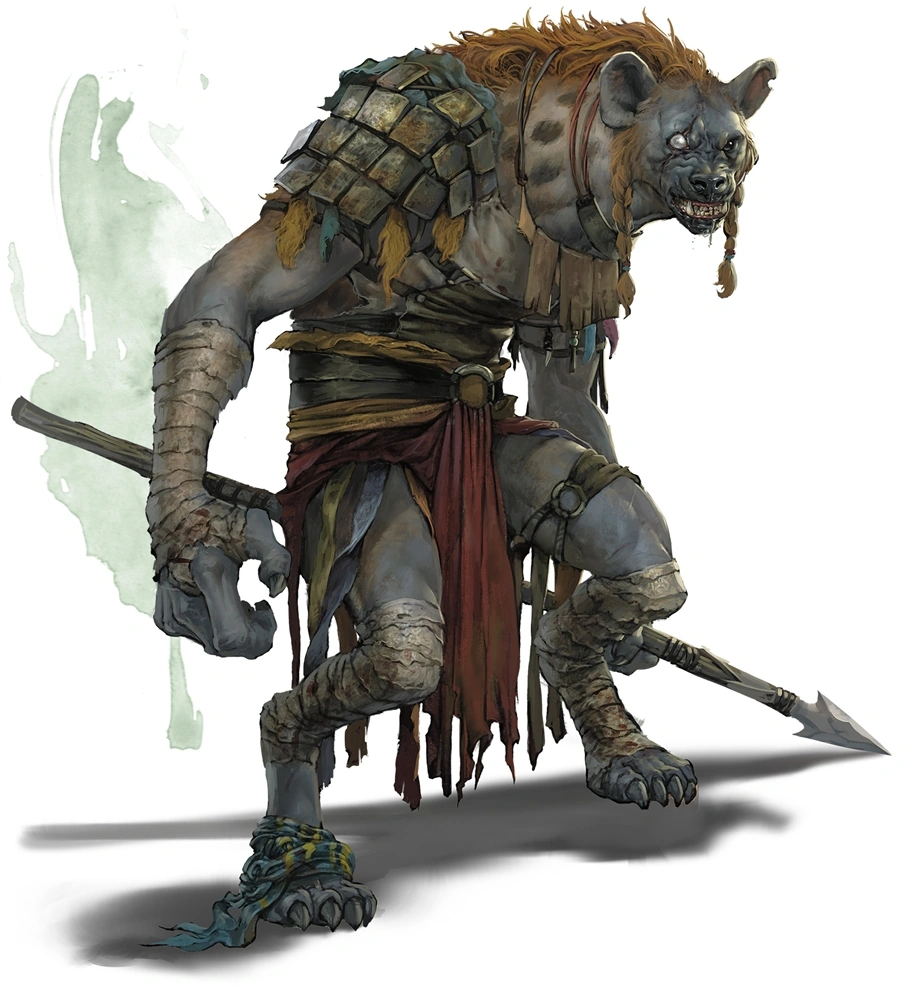
We're talking about Gnolls today. Or, as I like to call them, Hyena-men.

I mean, which sounds scarier? Gnoll:

Hyena-man:

You get the picture.

I always found packs of Hyenas to be eerie. That might be a consequence of so much footage of them being shot at night. There's something very "cryptid" about those eyes reflecting the spotlight.


 There's also something about their nature as pack animals (and scavengers) that robs them of the dignity that animals like Tigers have. Something about their hunched backs and shaggy pelts, like walking vultures. They've got an uncomfortable facial similarity to dogs, too; something too close to the familiar but dangerous because of its distance from civility. The animal equivalent to a stranger glimpsed by the light of a streetlamp in a bad part of town.

So Hyenas themselves are a wonderful blend of savage and eerie. But Gnolls? Eh, they kinda fall flat with me. Their officially-licensed, sterilized, brand-specific versions are always limp. Pathfinder Gnolls are... Just another version of Pathfinder Orcs, basically. Their entry is functional and punctual, like it's in an interview for stooge monster. 

The current D&D Gnolls seem to be under review to determine if they were secretly a racist caricature all along and I'll leave that to those whose needs are served by it. As for me, I only care about the fun parts of D&D Gnolls.

So let's talk about what rules about them. In Bullet-point form, the superior format:

  • Origins involve combining an already scary animal with a demon-god's rampage
  • Offer no redeeming value, only rapacious and bloodthirsty, so there's 0 moral compunction about fighting and killing them
  • No half-gnolls, no weird in-game ghettos, just straight-up invasive monster killin' fun. Good for the whole family
  • Reproduce by cursing their foe's bodies; when a hyena eats them, they become a Gnoll
I basically love everything about that. But I say we take it a step further, And I'm gonna do that by fleshing out the psychology of the Gnolls. Or, rather, hollowing it out.

Let me introduce another Hasbro-property that I adore, good ol' Scragnoth:


I pulled this guy from a Tempest booster pack when I was a teenager (this one is some kind of reprint I guess? It doesn't matter. Magic is crack) and I loved that flavor text: "Only counter-intelligence" hmm? I liked thinking about that; what kind of being had retorts, but no point? They'd have complaint with no critique, reaction with no thought. They could mock and imitate, but would have no capacity to create.

Man, how weird would THAT kind of being be, amirite?

Pictured: a totally unrelated message board

Our entire culture became Gnolls at some point, but for a little bit, the pack was confined to cramped and squalid places on the internet. Places where there were dozens or hundreds of stock meme-responses to any question, any statement, any kind of original content. Places that catered to a culture of clannish anti-thought, where the assumptions of how things were became the laws of how they must be. Where hot-takes were more valued than genuine engagement. Where an appeal to conventional wisdom was more valid than actual observation, experiment, or innovation.

A place without intelligence; only counter-intelligence.

Such are my Gnolls. Not just scavengers of mortal things, but ontological scavengers. Beings for which originality isn't just a sin, it's literally incomprehensible. They don't need social sanctions to deal with rabble-rousers who dare to shift away form the group-think; they don't even have group "think", their very minds are mirrors, pure reaction. A social survival instinct but never, ever any thought.

And then of course, you have that most famous hyena trait: their laughter.
 

Laughter and mockery have a tandem, defensive social function: they degrade an idea. Divorced from thought, they function in the same way, like antibodies; they recognize an invader, absorb it, change it into something that is no longer a threat. 


Scavenged armor, scavenged weapons, scavenged voices. These Gnolls don't have speech, they steal the voices of their victims, communicating solely in the dying words of prey followed by vicious, empty laughter. they're heard before they're seen


If Gnolls are encountered as wandering monsters, after determining encounter distance and surprise, roll on the following chart to determine what the party hears as the Gnolls approach. The voices are from previous victims, and sound exactly like these unfortunates in their last moments.

What do they hear? (d12)
  1. "I thought I heard something..."
  2. "My baby! My baby!"
  3. "Let go of me!"
  4. "Please don't!" Followed by a cry of pain
  5. Inarticulate shrieking
  6. "Die monster!"
  7.  Begging in a foreign language; sobs
  8. "Help! Somebody help!"
  9. "Let go of him!"
  10.  A warcry that abruptly cuts off into a gurgle
  11. I don't want to die I don't want to die I don't want to die"
  12. Weeping, then a cry of pain
On a d6 roll of 5+, this will be followed by the mindless laughter of the entire pack.

Every round the Gnolls continue to fight, roll again on this chart as they babble and laugh through the battle.

Memetic Instince: Gnoll packs absorb the voices of those they hear. If the players say anything in-character, one of the Gnolls present will say the same thing, in their voice on their action. this will elicit the laughter of the rest of the pack.

Replace one of the results from the above chart with the stolen quote.

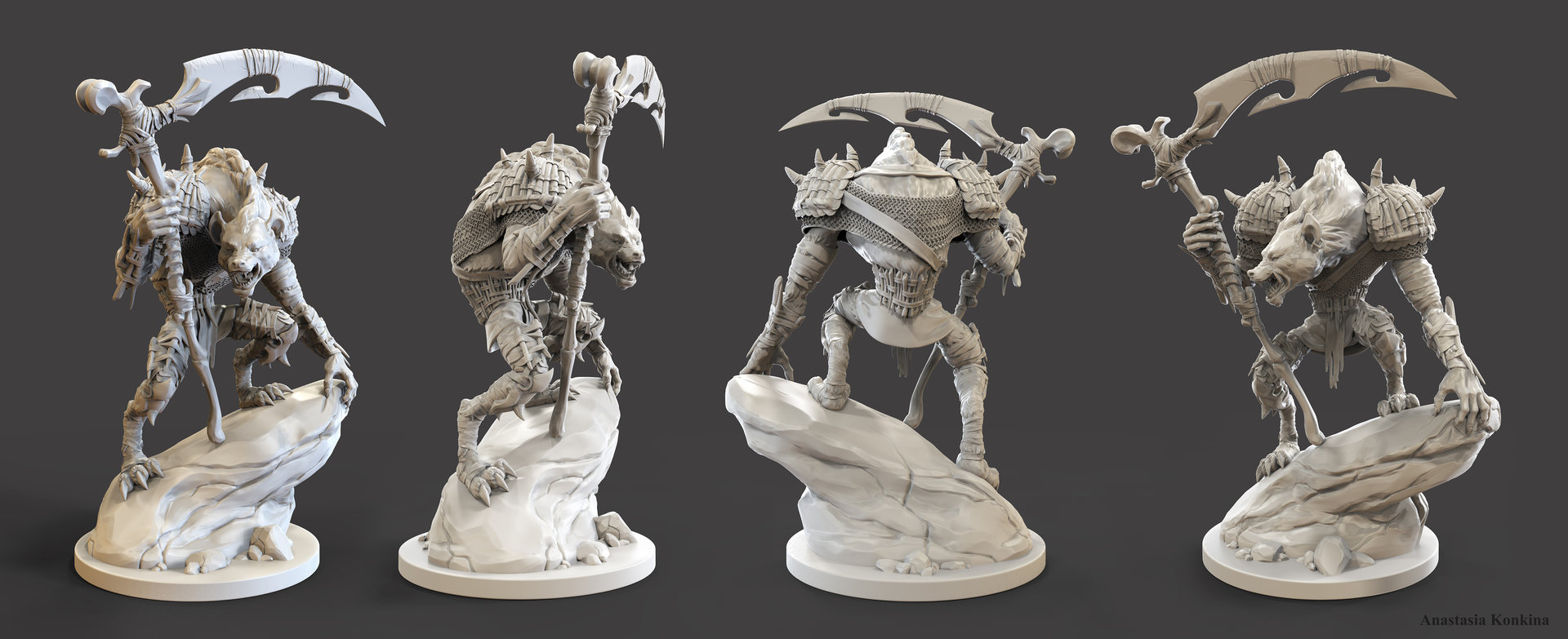
Sculpt by Anastasia Konkina, Based on a concept by Ilya Komarowski

Gnolls are commonly manipulated by powerful, evil creatures such as mindlfayers and liches, as they eventually become a reflection of their environment. A sufficiently cunning dark lord can engineer the Gnoll's parasitic culture to serve their ends.

Commonly, such packs have Hyena Diplomats that are able to speak and communicate (after a fashion) via a Helm of Comprehend Languages soldered to their skulls. Hyena Diplomats have an additional hit die, wear scavenged robes and aristocratic clothing, and tend toward the twitchy and socially obscene. They still interject inappropriate laughter into conversation and treat any original thoughts, social mores or ethics as a hilarious and slightly pitiable joke. Their weapons are invariable concealed, poisoned, and only brandished when the Diplomat sees no further use for their latest mark.

Tuesday, March 17, 2020

I don't like 5th edition but that doesn't mean it isn't good


I have a confession to make: I both don't like and admire 5th edition.

Prance! Prance against the giants!
I'm not in tune with the cultural zeitgeist this time around, I guess. Although I like the first season of Stranger Things well enough, and that Rocks and Marty is a pretty funny cartoon. I have trouble deciphering what the fuck is going on with a lot of this stuff:

I guess this guy's pretty normal, though

Here's some stuff I don't like:

1.  The players get stupid, stupid powerful, but the game keeps treating them like they're normal people. Like "Oh I'm going to go to the market and haggle cheese prices then cut a Basilisk in half later". Nobody recognizes the demigods wandering around and it bothers me. It's tonally incongruent.

2. There's no advice for running a game in the DMG. I had to get all my functional game-running advice from the Alexandrian; none of the subjects brought up in any of those actually useful articles is even hinted at in the $50 guide to mastering dungeons. I basically paid the price of entry to get my favorite mechanic from the D&D next playtest back, which was the skill die. It feels a lot better than the flat bonus. Fight me.

3. They use a bell curve on encounter charts! Why would you do that?!

4. Actually, they just stuff needlessly complex math into everything for no reason. The single-die systems for things like HD and encounter charts weren't just "stupid and simple", they were elegant and more functional than what you've replaced them with!

5. Why does everything have so many hit points? Is it because everything does piles more dice of damage for no reason? This smacks of solving a problem you yourself introduced by introducing yet more problems.

6. Is there any actual benefit to monsters having types? Ooo, you mean I get to know whether a Basilisk is a dragon-type or a magical beast? And I get to finally have official, cannon confirmation that a Brain Beast, a four-limbed giant brain monster, is an aberration? No fucking joke?

7. Paladins can be Atheists now? Who are they supposed to be appealing to, again?

8. Infinite ammo magic guns for all wizards forever. I once had a warlock treat his eldritch blast like a nail-gun on auto-fire strapped to his hand.


In defense of that last one, having a single one-time-use spell is pretty weak and always has been. I feel like, maybe reduce the die type of damage a step or something? Like make "I ran out of spells" still suck. Or maybe you've got to pass some kind of spell-casting roll to suck your magic well all the way dry.

...

I do admire 5th though.

It's so much simpler than 3rd, which is the edition I started in, and better-organized than any edition prior to that. You can kinda jump in with an idea and very rapidly cobble it into a perfectly functional and fun character; that's an impressive achievement.

I like that the game acknowledges that playing a role (you know, roleplaying) is fun. I get sick of the "it need social rules!" crowd sometimes and it's great to just level my finger at 5th and go "SEE?! TALKING LIKE A GNOME IS FUN ON ITS OWN"

I like that backgrounds are little packages of stuff you get. Like the criminal gets to break the law, that's fun.

I like the magic items quite a lot. It's clear they put some thought into limiting them so they're magical tools and not components of CCG-esque gonzo schemes.

I like that some monsters get to be extra most special monsters and have extra actions they can take to fuck with the players. It makes them hard to metagame and it's just a really neat idea.

Mostly though, I like how gosh-darn simple and friendly the whole thing is. It sacrifices a bit in terms of cohesiveness, and it certainly occludes it's inner workings needlessly from enterprising GMs (the better to sell you supplements, my dear) but as far as being something you can use right out of the tin: it's as delectable as pineapple spam.

Behold, Ambrosia

What's the takeaway here? How does this tie back to Tian Shang?

The takeaway is this: don't get too technical. You'll slam the door on too many of your fans. Not because they're dummies, mind you, but because, they're trying to use your game to have fun. Stereo instructions aren't fun; they suck. The clarity of instructions are great, but not if they're so painful to read that people don't bring them to the table.

Latest draft of LWF is scaling back on the technical elaboration considerably and it's a much stronger product for it. While writing it, I came to appreciate this aspect of 5th edition, so I thought I'd blog about it.

What? Sometimes they're only little revelations.


Tuesday, December 31, 2019

Trash setting


Well of course it's trash: It's the Apocalypse, smartass ;-)

But what's in a setting, anyway? What distinguishes your Yoon Suins from your Creations from your Greyhawks from your Dark Suns from your All Under Heavens?

I've gone on-record about how the simple length and game-mechanic-relevance of a setting's presentation distinguishes a playable setting from bad prose. But we're digging deeper than presentation here. What makes a setting one you want to play versus one you don't?

I've been giving this considerable thought as I create playtest areas for the game. which, by the way, tease time:


Yeah I haven't gotten those typed up but they're comin', folks <3!

But I've found the settings that excite me as a player and GM aren't just cool places with interesting stuff and cool creatures/societies: they're places where some kind of intrigue is going down.

Which makes sense: every great fictional setting that I've ever encountered is ultimately just a backdrop to a well-constructed, character-driven plot. Castle Amber is a fantastic setting, but it's empty without the war for the throne going on. Gotham is a brooding gothic megacity sure, but it's impact is in its relationship to Batman and his fantastic rogues gallery.

Namek is the perfect example of this. Because it kinda sucks as a setting, but some of the most memorable stuff in DBZ took place there.

LAAAAME
The genocide of the Namekians tugs at our heart strings; we're thrilled by the tense game of cat-and-mouse the characters play with godlike Frieza and his terrifying henchmen, we're fascinated by the growing power of Vegeta, interested in his relationship with the rest of the DBZ crew, excited and saddened by Nail's futile heroics.

Cool shit is transpiring like a motherfucker in THAT trash setting.


Megadungeons share this feature in common with beloved settings in that things are happening there. The distinct topography of different areas, coupled with the mixing effect of encounter charts, allows a fascinating and living co-mingling of the game-elements. sometimes you encounter that werewolf roaming the ghostly halls, sometimes he's out of his designated room and you get a chance to wait in ambush. But there's a deeper layer to this that distinguished great dungeons from good ones: relationships.

Because the great megadungeon describes the relationship the werewolf has with the witches coven in the haunted reliquary, that he's feuding with the gorgon in the sickly garden, and that he's the loyal pet of the chief vampire in the throneroom.

So the context of encountering the werewolf serves the function of informing players about the living setting. It turns it from monsters keyed to room and randomly remixed to a living, vital area with a history and characters and intrigue.

That's the spark that LWF's setting has been missing. That vital layer of relationships, interwoven plots, mutually incompatible plans, hostilities, rivalries, unrequited loves... The human element isn't there. It needs to be.

The Method

An excellent discovery, but how to implement it? As usual, in lieu of pioneering my own innovation, I'm just going to steal from somebody talented. In this case David McGrogan and his gem of a book, Yoon Suin: The Purple Land.

Buy it, you hacks!
Yoon-Suin has an elegant little system for establishing a setting that is the opposite of trash. It works generally like so:

1. You choose a broad chunk of the setting (a Domain, in LWF terms)
2. Flip to that area of the book and roll/choose one of the broader areas within that chunk (roughly equivalent to a Tract)
3. Roll for what the terrain is and contains (including some history and adventure hooks, possibly treasures)
4. Roll up what intrigues and problems the inhabitants are experiencing (This often hooks them into neighboring or otherwise connected places and peoples)

It's very fast, but it provides not only the cool places, creatures and peoples of the setting, but vitally, their relationships and intrigues with one another.

I've already stolen so much from Yoon Suin that I'm not shy about going back to the well: in this case, I'm going to dip out that all-important layer of Intrigues and plunk it wholesale into my Content creation rules.

In this way, you'll now generate:
1. Stable Content, in the form of terrain, inhabitants, and features
2. Dynamic Content, in the form of events that can transpire (similar to keying content to hexes in D&D)
3. A relationship web, including hooks into both of the content types above
4. Volatile Content, which is the equivalent of Encounter Charts and derived from all the above

Now to type up my notes for that Domain I've been working on up there. Stay tuned, True Believers!

Tuesday, November 12, 2019

Playtest thoughts and other things that are happening right now

Man, never try to write an RPG mid-semester. You'd think I'd have learned that lesson watching poor John Mørke practically kill himself on EX3 but no, I just gotta time everything like a complete idiot.

Playtests so far:

1. My primary in-house, consisting of 3 sessions total. Set in the Demon City fighting the nascent dark prince Rebi Ra, the party has yet to make contact with him directly.
Thus far:

  • Biker gangs have been punched down in bloody-knuckled combat
  • A meat stall owner was spared a grizzly demise
  • A miniboss fallen Golden Lion was put down after a thorough emotional flensing from the party's pet demon
  • The rooftop garden slaves were freed
  • The party was forced to retreat from the fire-demon guarding the approach to Ra's palace after it summoned a Rank 6 wall of wraithly fire to keep them at bay. Also, they were thoroughly burned by it's ghost meteors.
2. My secondary live playtest, which you can listen to in all its glory right here. 
Stuff that happened:
  • Our heroes combined their efforts to leap over the moat leading into the Demon City
  • Some evil cultists were Akira-exploded with a gory use of psychic powers
  • A kung-fu rivalry sprang up between the party and an invisible psychic prince
3. My tertiary one-off playtest, which also encompassed character generation.
  • The only cool thing of note was a kung-fu battle where yet more unfortunate bikers met a fiery end at the hands of Fire God's Breath. 
  • Are Radioactive Scorpions a draw for female players? Seems to be the case!

Additional stuff:

A series of videos about solo play are also in existence! Perhaps you'll find them entertaining, perhaps informative! In any event, here they are! 


There's a fourth one too, but the audio is missing so. I'll skip that one!

SO! What have we learned from all this? What's going into the next (and final!) draft?

I've got a few things from the starting-level playtest:
  • Character build options are a bit lacking. I mean, past the design intent; I need to finish character equipment options. Some options are a little cloudy (like which Gupt Kala/ Skill Masteries are available to Ronin, for example). Some tightening is called for.
  • Movement needs to be split into speed and maneuverability. There's clearly a divide there in the mechanics, but it's not adequately defined or supported.
  • Fields are too big, but zones would be too small. More thoughts on this directly.
  • Movement and traveling are still too fast.
  • There's some cloudiness between attacks, sustained actions, and hazards (what counts as what?).
  • The action economy has a lot of central corner-cases, like how many 1-die actions you can take. This is kind of inevitable, but annoying.
  • You need more Prana. There, I said it.
  • The content rules for how to prep still aren't as table-friendly as I'd like. There's too much asked per field; you just can't go from imagination to content as smoothly as I'd like.
  • The crafting and resource rules need some examples. Really, everything does, but these more than the rest because they dangle without support from the rest of the gameplay (Why am I making people mine iron ore again?).
  • I need to limit how high non-magic Emotional Imbalances can go Rank-wise; they don't have the same defense infrastructure as typical wounds, making them an easy way to get debilitating imbalances against a foe.
All that and some general tightening of things like the encounter rules and scene transitions would really make the stuff I've tested sing.

There's more to do than what I've been able to cover (god I'm so busy, then I got sick...). For example, I need to know how mid and higher degree characters interact, both with the environment and in terms of single battles and ongoing campaign play (such as linked battles, wars, shadow wars, etc.)

I guess this means I'll need to do some higher-degree testing in the near future: I don't want to overhaul anything really significantly until I see how the higher-level stuff feels in play.

Other notes:

  • The Gupt Kala need another pass. Maybe add some more Imbalance-based stuff, certainly add more terraforming stuff. I meant to put it in there but uh. Didn't.
  • There's a lot of little errors that an editor would have caught in the current text. I should give it a pass just to face-lift it. Ditto with outdated references (like to the Elephant Board, which doesn't exist since I changed Content) and double ditto for the layout, which is an eyesore.
  • Also need to change the font. Times is pretty hard on the eyes for extended reading.
  • The art's also pixelated, although I imagine I won't be able to fix that until I do the proper layout since my program for it came free with my computer (not a mark of high quality).
  • Even absent additional playtesting, I can tell the higher-level Techniques are going to need the logic of their costing and their place in the game examined more closely. As it stands it looks VERY likely that you'll not be able to access them without charging up significantly, which doesn't reflect their actual utility.

All this stuff is a bit dull, eh? Well, welcome to playtesting! It is a bit marginal and edit-y; that's the point! But I DO have some more exiting stuff to talk about!

For example, Lore are getting finished! And they're shaping up to be very ease, intuitive and modular bits of setting design. They've got lots of places to fit into the rules, what with Stable/ volatile/Dynamic Content and the Web of Masters and Dharmas and such, not to mention the resources, manufacturing and crafting systems. Lores are turning into a comprehensive "chunk of the wuxia setting" style resource, complete with intrigues and scheming masters and places to fight and reasons to war and character motivations and all the trimmings! Which is pretty exciting!

Another fun thing: Magic item examples are in the works. Right now they're largely refinements of things that exist within Techniques (has anyone noticed I changed the name of these to the Yuddhukhala? No? I like that better). But there's an additional layer I'm working in: magic items allow you to take magical things you find in the setting and turn them into sustained advantages. For example, if you happen across one of those "cures any ailment but only blooms once every century" style flowers, you could use it as an ingredient in a "cure-any-ailment-every-time-you-use-this" style magic item!

Doesn't stop there, though! As I work up content examples, I'm realizing that individual places and magical architecture features are extensions of this principle. Maybe there's an all-curing sauna that incorporated that flower in it's design, or a demon chained into a room where it has to answer riddles or grant wishes.

This is a great place for imagination to seep into the game; I need to do another, cleaner and more platested draft of the content preparation rules to bring that element to the forefront and give GMs confidence in doing it.


NEW KUNG FU

Yeah I'm gonna be making seven-ish more styles. Why? Few reasons:

  • Both of the precursor games have about that many styles, so it's a tradition
  • Most of the games in this genre have about that many individual powers total
  • I want to further clarify the design method of creating your own styles for nascent GMs and this is best done through considerable amounts of example
  • It makes me happy
What I'd ideally like to do is seven additional styles (one per clan) which are "full" with 10 Techniques apiece. Additionally, I'd like to do some "broken styles" with only the lower bounds of Techniques which can be encountered as fun easter eggs while exploring the wastes (like maybe there's some fallen clan that whip out an unknown style on you, or a lone master with a bunch of secret forgotten moves, or maybe the remains of the style are written in hieroglyphs on a forgotten temple wall).

I did some rabble-rousing and asked for style ideas. Here are some of my favorite candidates for inspiration/development:

  • A style where you gain the strength and characteristics (both real and mythical) of the woolly mammoth
  • A style based on Edgeless Blade from Thunderbolt Fantasy
  • A style that serves as a descended of Fox Spirit Song from Legends of the Wulin
  • A style internalizing the playstyle of classic "Suicide Black" decks from Magic:The Gathering
Clearly I need at least 3 more, but that's a solid start. Feel free to toss some ideas at me on our Discord and I'll absolutely steal them without paying you Listen!


YOU SAID SOMETHING ABOUT NEW FIELD RULES?

Oh yeah, I forgot I typed that.

Playtesting has revealed a design gap between my intention and the at-the-table experience: Fields are too vast for the kind of movement nuance the game has been designed for: there's a missing gulf between exploring an area and strategically moving within one.

So I need something smaller than Fields, but I'm having an issue because creating sub-fields defeats the purpose of making them that big in the first place. Let me demonstrate their development.

Here's the King's Road:


If you were to place tokens representing the character's position onto this map, they'd fit neatly into the squares. You'd track movement as taking a number of squares. This is familiar to most of us; it's what 3.5 D&D and Pathfinder use as their movement system. It's high-fidelity and gives every participant an exact measure of the tactical positions of every participant in a combat at any given moment in time.

It's extremely cumbersome to use this model though for a few reasons:
  • you need tokens representing every participant, which makes big crowds nearly impossible to model. 
  • It's also self-defeatingly static; characters don't actually move, then stop, then wait for their opponents to move, then stop, before moving again. They're constantly moving in a way that the "freeze frame" of this model doesn't adequately model. 
  • They kill imaginative description: why should I describe my guy moving and darting around, doing cool backflips and generally Jackie-Chaning their way across obstacles and terrain when you can SEE that your little token is just, doing a normal "move across the squares" move?
  • It punishes players for interacting with the interesting terrain: those bushes, ocks, all the remotely interesting stuff to interact with? Movement penalty, ranged attack penalty, attack of opportunity to approach a foe bunkered in it... It's all negative or, even worse, positive if you're doing the least interesting thing (which is squatting on it). This leads to tactically staid battles where behaving dynamically is punished and turtling and conservative movement is king (note that the vast majority of this "battlemap" is a ROAD or  featureless FIELD).
  • You need to onerously map every five square feet of an otherwise unremarkable landscape to allow any encounter to take place. The best-case scenario for this rings the death knell for any non-scripted fights, while the WORST case requires you to map entire cities in five-foot-square grids.
Basically it's a lot of work to use the squares model for ultimately uninteresting combats. I mean, just look at this monstrosity: it's legit a road in a field, but every painstaking inch has been placed on this (necessary?) map, so that all the tiny, niggling details of strategic movement which so much of Pathfinder's class system balance depends on can manifest and function. 

That's some agonizing over-design there, and it encourages a GMing model where you only have a fight if it's part of an "adventure path", rather than something that organically arises from the workings of the world. In other words, it's antithesis to the kind of game I'm trying to make here.

Clearly, I needed a different model.

Legends of the Wulin was a good place to start, obviously; so, I did. They used Zones from Fate, which are certainly better but still have drawbacks. Let me show you an example:


The organic, uneven lines here are a lot closer to the kind of battle-mapping is appropriate for spontaneous combats. You could sketch a hexagonal "wheat field" in seconds and surround it with irregular zones representing copses of trees, or houses, or adjoining fields. That comes with some hefty advantages:

  • You can define an area not by it's exact dimensions, but by it's tactical significance: the Hayloft Zone's precise size is less important than it being Above the Barn Zone and having the characteristic of being Full of Flammable Hay
  • As mentioned, you can sketch this out on a napkin in a manner of seconds, so spontaneous and emergent combat is preserved
  • It still allows both tracking of position and of tactical interaction based on positioning, but without the time-and-resource consuming fidelity demanded by the square grid
  • Movement within and between a Zone can be described dynamically and have a real game impact; in this case, the lack of clear boundaries and the presence of "fuzzy" edges defining them gives players a crack to wriggle through for tactically influential descriptions.
A better fit, certainly. But not a perfect one:

  • The lack of standardized boundaries is a recipe for tactical frustration; why can my spear reach into and through the houses, road and tree in that fat Zone in the middle, but fail to reach across the well in that tiny one in the dead center of the map? You have to torture logic to justify this kind of space-bending.
  • Describing a method for creating these organic areas is incredibly difficult; why are some Zones big enough to contain entire houses, while others are rooms within those houses, even different parts of the same room? Where do you draw the line between the apartment and the balcony? 
  • Worse, what about characters moving along the Z axis? Is the Side of a structure it's own Zone?
  • Abstracting the movement within a Zone has problems too; what's the mechanical distinction between a fast and slow character if they're both moving within the same Zone? The fidelity of the square grid allows a marginal advantage to accrue to the speedier character, but the abstraction of Zones erases this small but significant difference.
  • Positioning is also problematic; what's the mechanic difference between holing up within that house or standing in the open street in that fat Zone in the middle there? Clearly there need to be more lines, but again, where? Does it cost 0 movement to enter the house there, but 1 to move through the line that bisects the house in the adjoining zone? Why?
Although you may be able to individually resolve each one of these things, they each require their own, uniquely crafted logic to sustain the veracity of this model's internal reality; the second you forget one of these rulings, the model won't provide the answer any more. That's a big cognitive load, big enough to shoot the utility of this model right in the foot each time I tested it.


Enter the current model: Fields.

Fields are the current rule's attempt to find it's own battlefield space that solves the problems of the previous models.

  • They're big enough that they allow the kind of descriptive movement freedom that the genre requires; they also don't distinguish a Z axis, leaving that up to the relative positioning of characters in the Tactical Infinity
  • The abstraction of their separating lines aligns with both a descriptive and strategic difference: when city becomes wilderness, or when swamp becomes forest. This is top solve the "abstract boundaries" problem mentioned earlier: their boundaries contain the logic-answer as to why their imagined game-distance exists ("Your sword can't reach all the way from the neighboring building to to grassy field, you haven't left the building yet!")
  • Although unclear (missing, currently?) in the text, the advantage of occupying a piece of terrain is a modifier to actions: -1 Rank to you foe's attacks (effectively +1 Rank to your defense) if you've got a sizable advantage and  -2 Ranks if you've got  an overwhelming one (difference between the being in the high ground and being on the other edge of a concrete wall)
  • They're easy to prep and allow for any number of spontaneous combats to manifest in them due to their ease of use
You might I kind of threw my hands up at the whole "abstract but strategically sophisticated" angle; I leaned towards abstract because, at their core, these are places where you describe awesome thing happening. Lots of the tactical nuance of the game isn't so much in the moment-to-moment freeze-frames of characters caught in a specified XYZ coordinate, but in the interplay of Effort Pools, Prana and Technique loadout. The freedom of description was simply much more important than whatever imagined advantage I could grasp from refining movement and positioning with any deeper specificity.

At least, that was the idea.

The truth is my reach was exceeding my grasp here: modeling the complex 3-dimensional movement of characters WAS tactically important to gameplay in much deeper detail than this level of abstraction permitted. I just didn't know where to draw those lines that:

  • Allowed ease of prep and mapping, so both imagination and spontaneity were encouraged
  • Satisfactorily charted the positioning of characters in a complex 3-dimensional world (so that the nuance of speed and positing was preserved)
  • Upheld the tactical reality of that world without bogging down the system in undesirable minutia, so players and GMs could intuitively use positioning and movement based tactics to enhance play and fully engage the existing rules
That's a tall order for a set of rules. It also wasn't immediately clear which parts of the movement rules to work on to even begin solving any of that; should I work on the Effect Chart for Agility first? Should I put more development into Fields? How? Where? Where was I drawing the lines for Fields? How do you move between them, within them? What even is "moving within a Field", like what does that do?

It was a lot to think about. And it was a cognitive load on top of school and the rest of the bloody system. So yeah, I tossed my hands up and moved on. It was... Functional, if imperfect. Hell, that's more than a lot of games and enough to playtest.

So I defend my laziness in this case, while admitting that yeah, I did back away here.

And I followed through and playtested it. Sure enough, the Fields need more. Here's my current thinking.

1. Fields are largely functional as bigger "areas" that represent unique tactical "situations", terrain-wise. A tangle of twisting back-alleys and a bustling city square are defined cleanly both descriptively and in the tactical movement situation that they present to characters. In this regard, they're a triumph on the purely strategic level. No change needed there.
2. However, they fail to take to mechanically account for positioning, utilization of terrain for advantage, or the vertical axis.
3. Further, areas within the Field need enough definition that moving between them is necessary mechanically, not merely descriptively (although yes, you should be able to do both: there needs to be BLEED). Moving from the market stalls to the open area between them, leaping from that to the park area and splashing into the fountain there needs to be an exercise in boundaries that are crossed in mechanical and descriptive terms.

So I think, as part of the creation of a Field as Stable Content, I'm going to require the list of the Field's composite Zones. Let's take a gander at what THAT might look like by giving you an example of a Field from my Demon City playtest:

CURRENT FIELD: Aqrabuamelu's Territory

Description: Blood-streaked banners festoon the looming grey buildings here. They depict the crescent-claw of the scorpion. Blood-red lanterns, the stink of burning flesh and heavy incense invade the streets like a bright red tumor while the screams of human sacrifice echo across the concrete labyrinth. Occasionally, an inhuman voice will boom out, demanding tribute.
Terrain: Body-choked streets and 12-story buildings with macabre decorations.
Elements: Piles of bodies, burning censors, "x" crosses with human sacrifices writhing on them.
Inhabitants: Gasmask-wearing cultists of Aqrabuamelu (100 fanatics), sacrificial slaves (150 victims), Aqrabuamelu the Scorpion-demon and self-styled god.
Secrets: An entry to the subway leads underground

Pretty lovely, eh? What I've found though is that I'm not getting either the exploration I typically enjoy from dungeons nor the tactical decision-making that the described terrain implies. People aren't really spider-manning across buildings or anything neat, beyond a very superficial level. It's also not entirely clear where things are in relation to one another; I have yet to have the Scorpion Demon actually show up, despite being ostensibly "here".

What I'm thinking is that I can subdivide the broader Terrain description into Zones to solve these problems. My thinking is, I can capture the function of a map without requiring one to be modeled in complex 3-dimensional space (which would also be a nightmare to try to track in play)

Zones would work like this:

  • They would be separated by their Z-axis into tiers, one on top of (or below!) the other. 
  • Each tier would have it's own list of elements and terrain, with mechanics implied through it's description (by reference to the scene-actions and Effect Charts). 
  • The specific layout of the elements in a given tier would be descriptive, rather than mapped, with the default that all segments are "adjacent". 
  • Moving from one Element/Terrain to an adjacent one is free, but additional moves require Agility actions. 
  • Ditto with moving between Zones. 
FIELD UPGRADED WITH ZONES

Add the following to the bottom of the above Field

Zones
Ground: Bodies tied to crosses (various states of living), piles of hollow sacrifices, burning dumpsters, outlying streets, central podium with sacrificial altar
1st-7th tier: Blood and body-filled office building floors
8th-11 tier: Partially intact office building floors, broken windows lead to wires and hangings that link the outside in a spiderweb of steel and filth
12 tier: Rooftops

Look at how much more area is implied by the addition of a few simple Zones. They're more relationship-based than mapped, but there's a clear implication that, for example, you can't see the central podium (where I'll set Aqrabuamelu and his priests) from the outlying streets (where players will enter the Field). However, you probably can see the central podium form high enough in the buildings, even tightrope-walk above it for some Batman-esque shenanigans.

This isn't done; I need to run through the logic and see if there's more harm than good done by requiring the additional work, if this makes combat movement too muddy and unintuitive to track, what other parts of the rules need tweaking to make the change work (and decide if it's just way easier to do something else instead) etc. etc.

But I offer it to you, gentle readers, for your edification and enjoyment. If you've got some feedback, Come on over to our Discord where I happily read all of it and reply as often as I can. Until then, True Believers!


Monday, September 2, 2019

Lone Wolf Fists open playtest


Finally! Got this beast written to my satisfaction. And it only took an entire year longer than I thought it would! Yay!

Also still fiddling with the cover. Go! Get it!
Here's some ways you can thank me for making this awesome game:

Go and download it it for free! This helps my Dtrpg numbers and makes me happy!

Go and download it and pay literally any amount of money above that! This will be used to continue adding art and other fun stuff.

Become a patron and get access to a ton of additional content I'll be writing for the playtest and the final game! What will that content be? Places! Monsters! NPCs! New Kung-fu! Vehicles! Magic items! Disasters! Encounter lists! Mutations! And all sorts of other goodies that will eventually grace the full game.

Tell your friends about this game! This spreads my precious word of mouth and that's super important for running a kickstarter!

Run a playtest with your friends! You can do it privately or publicly; both help! Especially if you provide your feedback on our Discord server, the Fistoverse!

Make posts about it on gaming forums! I'll probably show up and answer questions and it'll be a great chance to let folks know about the game!

Do all that social media stuff the kiddies do nowadays! Like twoot, or go to facesbook and make a... Group? Chat? I'm a confused old man!

Ah man, I'm so excited. Thanks for the ride everybody; let's push this a bit further so we can get a physical book in existence.


Tuesday, August 6, 2019

The social arts (No I still haven't finished re-writing Heart! Bug off!)


Full disclosure: the Courtier's Arts were my favorite secret art. They had some strong contenders too; the prophecy-creating Scholar arts were conceptually brilliant (they did more for Sidereals at my table than hundreds of awkwardly-written charms ever did) and the Priest's arts essentially encapsulated all of the most gonzo stuff I love from stuff like Inuyasha and A Chinese Ghost Story.

Still, nothing truly compares to twisting somebody's heart inside out with your words. My favorite characters are always slimy social bastards. Take this beautiful monster for example:

Image beautifully crafted by Craig Mulligan, by the way
My Dune homies certainly recognize Harkonnen #1 the late, great reincarnate Baron Vladmir Harkonnen. A character so morbidly and deliberately obese that he cna barely move, much less defend himself in a galaxy filled with posthuman super martial artists who can see the future.

Yet, he's one of the most dangerous villains in the Duniverse. Hell, he's so dangerous that he effectively threatens one of the most powerful beings in the galaxy long after his death (at her hands, none the less!). The hell how is that sassy cow capable of being that deadly?!

He's smooth as iced milk is how. He's cunning and treacherous, and he knows how to leverage the darkest parts of the human heart to his inescapable advantage. He's a social manipulator par excellence; he can bend your desires into needs and ensure that he's holding the purse strings to your loyalty. His armor is reputation, his weapon is grace, and he coats in in the poison of your most shameful desires.

There's a lot to detest about him (read for yourself; Dune enriches the soul), but I love his insidiousness, his never-ending and self-justifying systems of intimidation, manipulation and cruelty that feed his invincible vanity.

Really, he's just the best bastard.

But, there's not really a good foil for him in Dune. His self-serving evil is countered by an equally self-serving practical literalism, misguided but sincere zealotry, and a futile and unproven appeal to the nobility of the human spirit. Not exactly a philosophical rebuke, it's all held up as essentially identical. At least, on the immortal and cosmic scale at which the characters of Dune operate.

But Legends had solid foils for their philosophical evils; at least, on paper. Every good virtue was balanced by an evil one; there was at least a well-set-up battleground for battling characters to test the rightness of their chosen virtues against their rivals.

The problem with Legends, as always, was that it was perfectly balanced; this is really the same problem spun in a different way. Our minds and hearts recoil from the uncanny valley of moral ambivalence that's implied both by Legend's stalemate and Dune's hyper-zoomed-out minimizing of the entire moral struggle. Our issues are too immediate, too hot in our blood to be answered in such a tepid way; especially at a table filled with intrigue, heroes, villains!

We want our good and evil to be immediate! We want consequences! Wicked villains! Justice-thirsty heroes! Glory! Righteousness! HONOOOORRRRR


Legends actually did a great job of this with the courtier Arts; you could totally adhere to good or evil philosophies, and your adherence to and spreading of them had in-game results.

My efforts were a bit mixed; I already made it so that anyone could be a social bastard by causing this game's analog to Passions, so I put the ability to be a philosopher sage and redeem people socially in the Gupt Kala.

This actually mirrors my personal relationship with emotions and philosophy; I've always been haunted by painful emotions, but it took a ton of sincere work and effort to learn about philosophies that gave me the tools to live an ethical life.

It also incidentally makes the art of healing with social interaction feel lost in the apocalypse, which makes characters that learn in rare and skilled; sort of psychologists of the fallen world, healing the broken hearts and minds of its people.

But don't get me wrong; they can also send them straight to hell with magically-reinforced contract law. Check it out:

...

Art of the Sage
Skill: Heart
Taught by: Golden Lions, Silver Phoenix, Five Star Spirits

Sadhana: The Seven Wisdoms
The devious manipulators of society can sow discord easily; a poisoned word in the right ear can twist the heart, filling it with anger, sadness, or obsession. But the sage learns a nobler path; the way of discipline, philosophy, and proper action. The Seven Wisdoms are destinies of proper thought and deed, doctrines echoing with the noblest aspects of the universe. 
These philosophical outlooks are created like Imbalances: however, rather than punishing characters and driving them into mad fits of passion, they inspire and reward them for noble and high-minded actions.
That is assuming of course that you’re working on a tight time scale (an Action scene) and that your target is unwilling to listen to your teachings. For willing recipients in Real-Time scenes, you need to spend only a single action to create the positive Imbalance. In Montage scenes, you may so empower any number of recipients to the zenith of your ability.
The most potent Imbalance that can be created depends on your Mastery level, according to the following scale:
Initiates: 2
Artists: 4 
Masters: 6
Grandmasters: 8

After it is created, any of these passions may be Inflamed by a Heart action from anyone, just like a normal Imbalance. However, only a practitioner of this Sadhana of sufficient mastery may “break the cap” and increase it beyond these limitations. 

The Seven Wisdoms
Earth Wisdom: Stoicism
Earth teaches this lesson: you can endure. Those taught the wisdom of the stoic withstand the hurts of body, heart and soul unbent. They stand where others fall, unchanged at their core no matter the agonies they suffer. When a Stoic chooses to act in accordance with a Dharma in the face of pain, danger or other hardship, they may claim their bonus.

Fire Wisdom: Joy
Fire teaches this lesson: joy can live in your heart. Those taught the wisdom of the joyful keep an undying zeal alive within them. When they act in accordance with a Dharma by sharing the joy of life with another, or defending that joy, they may claim their bonus.


Water Wisdom: Tranquility
Water teaches this lesson: all things seek balance. Those taught the wisdom of tranquility become islands of calm in a chaotic world. When they seek to fulfil a Dharma in the face of chaos, panic, terror, danger, or any other emotionally turbulent force, or when they defend natural or societal tranquility from violent disruption, they may claim their bonus.


Air Wisdom: Detachment
Air teaches this lesson: nothing is permanent. Those taught the wisdom of detachment comprehend that even the universe must one day return to nothingness. Not nihilism, but rather a recognition of the temporary and fluctuating nature of reality; a conscious rejection of the illusion of ownership and permanence. Their untroubled minds allow them to claim their bonus when they must make a significant sacrifice to fulfill a Dharma.


Wood Wisdom: Growth
Wood teaches this lesson: that which lives must grow. Those taught the wisdom of growth understand this vital direction; they seize, encourage and cherish growth and the natural blossoming of life. When those following the natural way seek to fulfill a Dharma by protecting, encouraging or experiencing growth may claim their bonus. Note; cancer grows as naturally as a flower: encouraging the growth of a wicked philosophy fulfils the requirements of this advantage.


Metal Wisdom: Logic
Metal teaches this lesson: with thought and effort, you can comprehend this world. Logicians seek to understand their world through careful thought, experiment and deductive reasoning. When logicians seek to fulfill a Dharma by approaching a problem which thwarted them with a new strategy, they may claim their bonus.


Cosmic Wisdom: Enlightenment
The Cosmos teaches this wisdom: truth exists in impenetrable mystery, necessarily beyond the knowable and known. Students of this recursive and elusive wisdom achieve harmony in the absence of mind, what the ancients called Divine Emptiness. When an adherent seeks to fulfill a Dharma by enlightening an enemy of its true meaning and purpose, they may claim this bonus. 

Mudra: Mandate of Fire and Stars
Treaties are the laws that bind societies; how much more so when sanctified with the implacable will of Heaven and backed up by the cruelty of Hell? The Shadow Arts Master ratifies the agreements of nations, codifying their rules of engagement, drawing their lines of battle, and ensuring their conjoined loyalty with the all-destroying blade of the gods dangling precariously above.

This Mudra allows the creation of Divinely Sanctioned Treaties; these agreements are backed not by arms and threat, but by the deep and vengeful sorcery of the cosmos. Those that dare break their sworn word face the wrath of Heaven and all the furious reprisal of Hell.

This Gupt Kala expands the Heart skill, allowing the creation of divinely-reinforced agreements between parties. These magical contracts are constructed thusly:

 Two or more parties agree to be bound by a sworn covenant. Anything might be agreed to, but there must be some tangible benefit for all parties involved; the divine withholds its blessing from an agreement which lacks some token peppercorn of consideration for all involved.
All parties further agree to be punished under a sanction should they violate their agreement. The degree of the Sanction determines the difficulty of the required Heart action to bind the treaty (1 Step= Rank 2, 2 Steps= Rank 4, 3 Steps= Rank 6, and 4 Steps= Rank 8)
Any caveats which allow exceptions to this are clearly laid out and agreed to as well
Finally, in the witnessing of the Shadow Artists, all parties formally swear to the covenant

To successfully bind the treaty together, the Artist must use a Heart action of appropriate Rank. Greater levels of mastery allow ever more terrifying sanctions with powerful enough action.

When used to sanctify agreements between individuals, this Mudra may be used in a single Real-Time action. To bind larger Populaces together, it requires a Montage action and representatives who Heaven and Hell recognize as speakers for those bound by the covenant.

Covenants last as long as specified in the agreement. If an expiration is not agreed upon, then it lasts for either the lifetime of all parties and their inheritors, or until dissolved by mutual agreement; whichever comes first (usually the death one).

The classic covenants
Over the long cycles of history, some covenants have emerged countless times as useful and predictable agreements between societies.

Trade Agreement: The parties involved agree on terms of trade between their societies. This might involve tariffs for importing foreign goods, or allow only certain items to be traded, or certain people to traffic in certain goods. It might restrict certain varieties of trade, or place minimums or upper limits on certain types of goods.

Alliance: A formal declaration of comradery and cooperation between societies, especially useful in times of war and other strife. May require allied parties to join forces in the wars of any ally, mutual defense for a shared border, or merely monetary support of one another’s war efforts.

Non-Aggression Pact: A less cumbersome agreement than an alliance, this covenant formalizes a lasting peace between its signers. Although lacking the reward of a full alliance, this agreement has been skillfully maneuvered into effective wartime defenses as nations select foes and non-aggressors to cover their flanks. It is also a classic first step on the road to trade agreements and alliance, so makes an effective “gateway” treaty.

Honor Duel: Sometimes wars last so long and claim so many lives that everyone involved gets completely sick of the entire affair; still, honor must be served. In these cases, a formal covenant outlining the rules for duels of honor is extremely helpful to create some token bloodshed in service of a greater peace.

Letters of Marque: Civil society sometimes has need of skillful scoundrels to selective break their own rules. In these fringe cases, it’s best to be legally clear about what these ne’er-do-wells are officially allowed to get away with. These covenants codify selective wicked deeds that their bearer may perform under the full blessing of the law. This protects the sanctioned wrongdoer from the consequences of their own actions and legal reprisal.

Sanctions
Destiny itself upholds the covenants of the Shadow Artist; those who break their sworn vow must face the furious wrath of the heavens and vengeful universe for their trespass. Less skillful artists negotiate for direct and temporary punishment, while the legendary grandmasters call down curses to ruin civilizations that dare dishonor their treaties.

Sanctions are Dynamic Content which is unleashed if a covenant is broken. The more powerful the Shadow Artist, the more steps are added to the content. An Initiate only has one, while a Grandmaster has all four steps.

The Catalyst for these is all the covenant itself. If there’s some dimension of the agreement that allows those breaking it to squeeze out of punishment (such as a Caveat, p.XX) then this can remove the Catalyst and cease the sanction. 

When a covenant is created, the master chooses the depth of the Sanction, up to the limits of their capabilities. For example, they might create less onerous treaties with lighter sanctions, if they wish.

Plague Sanction
A wasting sickness seizes all those who trespassed against the covenant. The graveyard of the world is still choked with the bones of those claimed by this horrifying covenant. Weaker levels of this sanction effectively create weaker illnesses; the higher echelons, adding as they do ever more horrible symptoms, 

Montage Dynamic Content
Initiates (Step 1): The oathbreakers come down with fever, sweats, and a hacking phlegm-filled cough.  This is a Rank 1 Sickness Imbalance. It’s dramatic penalty is identical to a chest wound, as character double over in hacking fits due to any strenuous activity. Characters that come into contact with a plaguebearer suffer this and all other stages of the cursed illness unless they succeed on a Rank 2 Endurance roll to fend it off.
Artists (Step 2): The fever breaks, and the plaguebearers devolve into shuddering chills. This a Rank 2 Sickness Imbalance. It’s powerful to kill between 1-10% of a Populace that contracts it after one Montage scene (roll a d10). It’s dramatic Penalty is akin to having both legs broken; the character’s cold chills and shaking make grace and speed impossible.
Masters (Step 3): The chill takes it’s next form; hideous boils, vomiting, diarrhea, and thick, yellow sweat. This kills and additional 1-10% after the conclusion of a second scene (roll another d10, adding to the first’s body count). Characters this sick have a Rank 3 Deadly Sickness Imbalance; if they take the dramatic penalty and roleplay the horrific symptoms above, they gain 1d10 Aggravation.
Grandmasters (Step 4): Those few unlucky survivors begin to rot; their flesh deepens into the color of a bruise and their flesh necrotizes. Their tongues swell with pus, and their eyes bleed out of their skulls. Only 1-10% of an affected Populace will survive this horrific malady. Characters with this plague have a Rank 4 Deadly Sickness Imbalance; its Dramatic Penalty is a complete shutdown of both arms and legs, and comes with 1d10 Aggravation for trying to act at all.

Famine Sanction
The material wealth, typically food but really any possessions, of the oathbreakers crumbles away, putrifies, rusts, or otherwise gradually becomes worthless. Much of the wealth of the ancient world melted away due to this merciless sanction. Weaker levels of this sanction impoverish or starve those who dare to break their word, while the higher levels turns all the world’s wealth into their foe; taunting them but offering no comfort, no sustenance, no shelter, and no aid.

Montage Dynamic Content
Initiates (Step 1): What could be chalked up to bad luck causes 25% of a Poulace’s Productivity to become worthless (locusts swarm wheat fields, cave-in bury precious ores, machines go awry and delay production, etc.). Each affected character additionally loses a random 25% of their least valuable material possessions due to accident, carelessness, and annoying misfortune. 
Artists (Step 2): Clear and unambiguous misfortune causes the loss of the next quarter of the Populace’s productivity (up to 50% now). Characters lose the next 25% of their material possessions, sparing their most cherished and powerful but otherwise ruining whatever else they claim as their own.
Masters (Step 3): Horrific, clearly magical misfortune destroys the lion’s share of a Populace’s Productivity (an additional 25%, for a total of 75%!). Character’s lose 75% of their worldly wealth and possessions, even cherished, irreplaceable and powerful items.
Grandmasters (Step 4): Heaven withholds even the barest mote of fortune from the doomed Populace that advance to this stage: the entirety of their wealth and worldly good (even food!) is annihilated in a cursed disaster, leaving them to starve. Characters are similarly impoverished. Furthermore, any who dare offer them aid are quickly stripped of their wealth and food as well, suffering the curse along with the unfortunate character!


Mischief Sanction
Bad luck, misfortune and a generally miserable fate befall those unfortunate word-breakers that defy this sanction’s covenant. This ranges from annoying and only modestly dangerous to full-blown cursed with an inescapable fate. 

Montage Dynamic Content
Initiates (Step 1): Troublesome and irritating coincidences, misfortunes, and a general souring of luck plagues a Populace under this sanction. Although not enough to do more than annoy them, their Status Quo changes to reflect their bad temper and poor fortune, and NPCs will comment on their bad luck. For characters, they must roll twice for any Volatile Content, accepting the result of the GM’s choice.
Artists (Step 2): Incredible and dangerous bad luck befalls a Populace at this level; this counts as a Minor Hardship, and NPCs will be desperately praying, practicing taboos, or otherwise indulging in any superstition to assuage their horrible turn of luck. Characters labor under the burden of a Rank 1 Bad Luck Spiritual Imbalance. It’s Dramatic penalty requires the full engagement of either a hand, foot or sense in the practice of a weird ritual taboo to ward off their misfortune.
Masters (Step 3): Legendary misfortune plagues a Populace at this level, counting as a Significant Hardship. The people cry out to the gods for mercy and are desperate for a cure to their woes. Characters must content with a disastrous Rank 3 Bad Luck Imbalance, Further, They must roll for Volatile Content no matter what they’re doing at the start of every scene.
Grandmasters (Step 4): Doom befalls the luckless Populace that suffer under this sanction; this counts as a Major Hardship. NPCs you meet are wrecks, bemoaning their cruel fate. Characters endure a crippling Rank 5 Bad Luck Imbalance, in addition to the increased Volatile Content above.

Monstrous Sanction
The World of Ashes and Ghosts once was known by another name, when it belonged to the merciful and creative hands of humankind; in this fallen age, it is gripped instead by the claws of crueler masters. This sanction steers the destinies of ever deadlier monsters towards those foolish enough to go back on their oaths.

Montage Dynamic Content
Initiates (Step 1): Vermin plague the oathbreakers. Populaces have their food stores eaten and spoiled, losing 1d10% of their food: this might cause a Hardship if there’s not enough food remaining to feed everyone. Characters have a terrain-appropriate swarm of vermin arrive as Volatile Content to trouble them.
Artists (Step 2): Opportunistic beastmen, mutants and other dangerous creatures are drawn to the oathbreakers. Select an appropriate local Populace of monstrous humanoids to prey upon a Populace; they become keyed to the area and the Status Quo changes to reflect their parasitic nature. For characters, this monster Populace hounds them, sending Groups alongside any Volatile Content encountered to opportunistically attack them.
Masters (Step 3): A powerful monster (Effort 7+) arises from the deep, dark places of the world to wreak havoc. Populaces endure a Significant Hardship as it lairs in their territory, permanently changing the Status Quo as it uses them as a food or slave supply. Characters must deal with the creature as though it were Volatile Content.
Grandmasters (Step 4): A monstrous demigod (Effort 12+) is summoned to rain horrors on the oathbreakers. A Populace endures a Major hardship and, should they survive, must live under the bootheel of the creature (either as it’s favored food supply or as a conquered people). Characters must vanquish the beast as though it’s Volatile Content; if they fail to kill it but otherwise drive it off, it will heal and trouble them again at every opportunity.


Caveats
As they say: rules are meant to be broken. In the case of caveats, they can at least be bent. A caveat is a specific, intentional exception to following a covenant. Although a player is always free to plead their case to the GM, the existence of caveats helps strengthen a Player’s ability to break their word and worm out of the consequences. 

The classic caveats
Over the long stretch of history, a few classic caveats have emerged.

Trial by Duel: A trespass against the covenant must be ratified by a public accusation. The accused may absolve themselves against wrongdoing by challenging the accuser to a duel to the death and winning. This caveat is favored by the Gold Lions and other martial brotherhoods, since it encourages justice through martial excellence.

Caste Immunity: Certain societal castes are simply not bound by the covenant; such is the privilege of power. This caveat is favored by the Silver Phoenix and other royal-minded clans, as it solidifies their power and keeps their subjects in their place.

Knife in the Darkness: If the trespass has no witnesses, the covenant ignores it. This is a favorite among the Shadow Vipers and other groups of assassins, as it encourages the sharpening of killing skills and subtlety by rewarding it with freedom from consequences.

Ritual Exception: If certain circumstances are met, the covenant selectively does not apply. For example, a covenant against killing might be waived against those that betray their clan. The Emerald Kirin and other ritualistic clans favor this caveat, as it ensconces the rules of society within the framework of religion.