Patreon

Friday, April 26, 2024

Urbancrawls in the Post apocalypse: Making Radical Ink

 We're doing URBANCRAWLS today


First, some recognition:

This blog post is founded on ideas that I encountered in three places:

The Alexandrian: Thinking About Urbancrawls 

Vornheim, the Complete City Kit

The Yellow City, from Yoon-Suin: The Purple Land  (Available for purchase here)(Also, there was a recent kickstarter)

My thinking is going to references these sources. I'll try to introduce and credit the ideas, but I'm imperfect and I'll likely screw that up. Also, you guys might like to check these out for yourself, they're all incredible.

Now, on to the show

...

What I'm trying to do here is simple: I want to make the minimum amount of prep, that creates the biggest city in the minds and play-experience of the players. I want it to be explorable, destroyable, feel "real", and feel vast. I want it to be conquerable, and to be reactive like a real living place would be to player actions. It needs to have tactical considerations and its own character.

Simple, right?

Since I'm the one doing this, and since I'm big on getting as much out of my work on elfgames as possible, I'm going to work through the prepload for Radical Ink, a city in the post-apocalypse hexcrawl I'm writing for my Discord game.

So, what am I going to need out of Radical Ink for my game, keeping in my mind I've got to hit all those goals?

Well first, its best to start simply and enthusiastically: With a single good idea. I've often touted the idea that "Your prep extends as far as your good ideas", and I think that's a strong maxim for making the best possible content you can. 

However, there's another important maxim I want to cleave to as well: "You need silence between the notes"

What's that mean? It means that for every good idea that you turn into a room in a dungeon, you make an empty room right next to it. It means for every hex bursting with personality and radical stuff, you have one that's just grass and hills.

"But why the fuck would you do that, you charismatic sex-god?" I hear you ask. Well prepare your brain to receive my genius, mortal, because it's coming out like a fire hydrant. You do that because the process of play demands it. Those "empty" rooms and hexes are filled with something you didn't anticipate, but critically need: the room to play the fucking game. You make "empty" content for the same reason you avoid stuffing every square inch of a room with furniture: because you need room to live. In prep, you need room for your players to play.

The practical benefit of this for prep purposes is that it inflates our prep to about twice the size of our good ideas, which is just about how much prep we need to actually run a game. There's one more component that fuses two opposing but vital elements: the need to Be Lazy (for us prep-generators, nothing is more vital) and the need to Be Consistent (which is anathema to creative types).

This last step involves a random content generator that gives consistent setting-appropriate results. The method of using it requires more "empty" areas, or minimally filled ones, used in conjunction with these generators to create procedural content which is still consistent with our established setting. This is useful for allowing our content to grow as needed to both increase its scale in a real sense and to increase the psychological impression of enormity and continuity in the players.

Okay, with the preliminaries out of the way: Radical Ink


What do we need to bring this city to life and keep it alive in our campaign?

My suspicion is that we need to start with three things:
1. What this place does
2. What protects it
3. The consequences of those two things

We need the first to give our city a sense of identity. Since I'm basing this city off of Legend of the Wulin's Magnificent Ink, why not make it a place of art and leisure? Buildings utterly soaked in spray-paint graffiti, air filled with music, bohemian lifestyles, colorful theatre troupes, all that jazz? 

Filling point 1 gives me a core to work with and it tells me something about this place and its people: they make art, and they therefore must be able to make a living from their art. Their art is a commodity, and commodities imply the right to barter with them for your needs.

Shouldn't these people become very quickly enslaved; forced to perform for the delight of warlords? Their art stolen or destroyed? Well yes, logically; this is the post-apocalypse, being able to eat every day is a luxury few can afford. How can these people not only survive in these harsh conditions, but thrive enough to warrant an entire city?

Enter point 2; there's got to be something protecting these fragile artistic types, enforcing their property rights, and facilitating their ability to barter. They've got to have a warrior caste. Not only that but this caste must have a philosophy that requires them to be protectors and encourage this artistic flourishing, rather than rapacious barbarians who will just do what rampaging foreign warlords threaten to do here.

Point 3 is where things start to get tasty. We get to exercise our creative muscles and think about the necessities and consequences of how these artists and this warrior caste interact. This is the opportunity to inject some real personality into your prep, and this is necessary because you'll get tons of content from it, both specifically prepped content and the content generators. 

Is this a divergence from "minimum viable prep"? I don't suspect so: You CAN do this, and you SHOULD in your own prep. Any time you have a good idea (or the opportunity to generate one), you should use it, even if it's "more work"; it pays off so deeply that you'd be a fool to spare yourself the additional prep time to bring a great idea into your game.

Incidentally, I actually have a fucking radical idea where I base this warrior caste off of the Five Deadly Venoms, making five competing schools that all have a mercenary arrangement with the artists. 

God this movie rules

So we've got the heart of this content, what do we need next?

Let's steal. From the Best.

Yoon-Suin's Yellow City starts us off by giving us a beautifully written section of in-character prose describing the city and it's many interesting peculiarities. If I were going to write this as a book for broader use, I would certainly want to do this, but for our purposes we can eschew the prose and keep the essentials, a bulleted list of facts about the city:
  • It is Yellow (due to quartz in the clay of the buildings)
  • It is ruled by a brahman-caste of slug-men (magical hermaphrodites, I love them) who are the only ones who can own property
  • They love tea, opium, and being smart
  • Its stinky
It then proceeds to give us a very minimalist description of setting up a game in the city (something to the effect of "put down a few districts to start then add as needed", followed by pages upon pages of content-generating charts). 

Yoon-Suin does two incredibly smart things here. First, the charts are fucking brilliant "breeder"-style charts that both minimize your work as a chart-maker and maximize their utility while providing both content and setting consistency, but even smarter than that is the second thing it does. The second thing is that it tells you, explicitly, to leave yourself room through vaguery.

There's a tendency among us content-crafters to fill up every square with specificity. The earliest urbancrawls were this, dense and detail-rich maps stuffed to the point of unusability with content. Just look at this monstrosity:


I don't have time, in the heat of running a game, to parse what I need out of this. It demands that I know about it beforehand, memorize it, develop an intuition about it, and I just do not have time for that bullshit.

The license for vagueness gifted to us by the Yellow City allows us be the ones crafting this detail into a bigger, more immediately accessible description of a given part of the city. This means that we're developing that intuition and prioritizing the information in our entire game table's collective memories through the experience of play, rather than fruitlessly front-loading our brains with trivia that will in all likelihood never get used

Because we're not filling in this detail until we need it, we're getting the best of both worlds. All because we allowed ourselves the freedom to come to the table without either writing it down or memorizing it beforehand.

So we're taking three things from the Yellow City method of urbancrawls:

1. A list of facts (turn into prose to taste)
2. Breeder charts for content
3. A license to keep things nebulous until we need detail

Let's start stealing from the next genius:

I'm actually taking surprisingly little from The Alexandrian's urbancrawls. Primarily, this is because my goals differ from Justin's; I'm not really interested in running an open table like he does, so really brilliant stuff like the Conspyramid just don't have the same utility for me. 

But his thinking on Districts (does he call them that? Fuck it, its a good name) is of incredible value to me: it matches very well with my idea of Tracts. A city's terrain is mostly artificial, and designed purposefully to reinforce a type of activity. Tracts are geographic areas created by nature (mountain, forest, etc.) that have a contiguous environment. The Venn diagram between these two concepts is almost just a circle, so we can map Justin's ideas about Districts to our rules for Tracts.

Generally I map Tracts 1-for-1 to hexes on my own maps, but this allows us an alternative where we can squeeze a bunch of Tracts into a single hex by making our own little district map.

Also, these are easy to find online

So we steal Districts and map them to Tracts, allowing us to fill them with landmarks that can serve as Fields (which you'll recall are "cool places to fight"). We'll use more breeder charts here so that we can procedurally generate these places as the game demands. Wonderfully, this maps to our intuition for what a Field in a city should be; they should be like stages from a fighting game.


Districts do something else that is very important for us: they let us "chunk" the city into bits that can be controlled, conquered, and otherwise played on a macro-scale. You can use the Districts as Nodes, leveraging them for Domain Play. You can police them with Forces, which has hooks leading into investigative playstyles as well as urban war scenarios.

This allows us to think of Districts, which are very large-scale, similarly to how we think about rooms in a dungeon. We can run them at this scale using our License for Vaguery; we can describe and generate any number of places within a given District to make it infinitely explorable.

Districts additionally create an ecosystem out of the city as a whole if we define their relationships to one another. X district produces food, sending it to Y district where most of the populace works in a bullet factory. Z district has a criminal empire that supplies vice to them both. And so on.

So what are we taking from The Alexandrian's Urbancrawls?

4. Chunk our content into Tract-sized Districts
5. Use of Terrain Breeder charts to generate details as needed
6. Use Districts like Rooms in a dungeon
7. District relationships


Our last point of theft is going to be from good ol' Vornheim. 

Vornheim has a good habit of populating its city with memorable power-players that may take an interest in you (or that you may want to fuck with). They live in interesting places for an adventure. Most importantly, they have stuff going on that you will likely get caught up in.

This works gangbusters for our purposes, because that is precisely how wuxia characters work.

A New Challenger Enters the Ring


Sheesh, sorry about that completely unrelated interruption folks! (Steal the Grudge Charts from this game)

We can take this design ethos and make some Important NPCs (which is to say, some bosses for our players to fight) and give them some Places that they're generally hanging out (Strongholds or HQs or Dojos or Brothels That Are Actually Training Grounds For Assassins or whathaveyou) and some Plots that they're hatching. This can double as our "Conspyramid/Urbancrawl Layers" so that players have some meatier content to hook into when they come to our city.

This means we'll have some:

8. Major NPCs
9. Places they're generally found (Lairs, if you like)
10. Plots which represent the stuff they're doing

....

Putting it all together, we get the following template for our Urbancrawl:

Of course, you might want more of something, like maybe you've got a bunch of populations you want to write in, but that's a matter of tweaking this more general template rather than reinventing it

I decided to leave in a big pile of places in the master list if you wanted to stuff it with a bunch of unique NPCs, but you can also take up ranges if you want to do it demographically.

....

So, let's fill this in with Radical Ink

Name is an obvious one

Facts are gonna be:
  • City of artists
  • Graffiti everywhere
  • Ruled by five clans of warrior/mercenaries who know five different kinds of kung-fu
  • Consume Rice, Opium and Games
  • Leaders wear masks and are anonymized
That should give us some memorable aspects of the city for players.

Now I only have two types of populace here, Artists and Warrior, but you could actually have as many as you like. Here, you can even use this sheet if you like:

I threw some more templates for NPCs and plots in there too

ANYWAY, we need to fill out ours. I'm loosely basing this on the way that Yoon-Suin does social groups, which is to say that what we should result in here is:
  • Petty groups of people
  • Who have a few standout points of contact for the players
  • Are memorable "guys who do/are X"
  • And they have a job for you to do
This is easy, as we can steal from our favorite media, file the serial numbers off, and wind up with some actionable content. For example, see if you recognize THIS award-winning modern classic:

NPC1: A well-established but talentless musician
NPC2: A young, brilliant but unstable musical genius/upstart
FLAVOR: Musicians supported by local hyper-wealthy fops
TASK: Poisoning a rival

Or what about this timeless tale:

NPC1: An untested but incredible new talent
NPC2: A reclusive and antisocial master of the craft
FLAVOR: Local theatre troupe who produce enormously popular new plays
TASK: Kidnap a new paramour for the leader

Yadda yadda, you get the idea. We do this for both of our groups and it allows us to mix-and-match between the results because these are breeder charts. So you might get:

NPC1: A well-established but talentless musician
NPC2: A reclusive and antisocial master of the craft
FLAVOR: Musicians supported by local hyper-wealthy fops
TASK: Kidnap a new paramour for the leader

And suddenly you have a unique result, a different group with a slightly different mix of personality, talent and drama. The more entries on your breeder chart, the more varied the results.

The five slots I've got here should map nicely to a d5, and they should be sufficient to give us lots of variance for procedurally-generated content.

The District Map I've provided here has an underlay of hexes if you just want to fill in their general spatial relationship or keep in the traditional mapping, but feel free to doodle in whatever shapes you like if you want a more map-y definition of the Tracts. I'm sticking with hexes here, since I already have a space carved out for them on my hexmap.

This space right here

The districts Only need enough to give you that entitlement to vaguery; they're describing the outside edge of a very big box, which you will fill during play as the need arises. That's a weird idea to wrap your head around, so here's a few examples:

DISTRICT: Resplendent Prism
OUTLINE: Bazar of the Bizarre
FUNCTION: Market III, a place to buy, sell and trade
POPULATION: Colorful merchants hawking their wares

There, we can make this Hex/District 8107 up there and now I've got a nice fat hex to play in. What I describe there is going to be loosely bounded by the elements in the District entry in that 

  • NPCs will be either those merchants or some incidental thing related to them, like bodyguards or buyers
  • Places will be things like market stalls, shops, or something related to those things, like alleys leading to illicit goods marketplaces
  • The rules-function of what players can do is here defined: it's a Rating 3 Market, which is defined concretely in the core book (go buy it you cretins!)
When you need a Field on the fly, or really any time you need to make a Place in any amount of detail, you use the Field Generator. This is also made in the Yoon-Suin mold, giving you

  • A Place
  • That is in a State
  • And has something memorable about it
Another example is called for here, so let's keep adding depth to our new District

STATE: Surrounded by clouds of opium smoke and incense
FEATURE: A free-standing tent overflowing with strange goods
SPECIAL: A rival merchant's agent is here, trying to spread rumors about the low quality of the merchandise for sale

Or maybe

STATE: Covered in brilliant graffiti-art
FEATURE: A hidden shop peddling illicit goods
SPECIAL: Bouncer at the entrance that only lets in select clientele

Since you're putting these on a breeder chart, you can mix-and-match for fresh results

STATE: Surrounded by clouds of opium smoke and incense
FEATURE: A hidden shop peddling illicit goods
SPECIAL: A rival merchant's agent is here, trying to spread rumors about the low quality of the merchandise for sale

See? There are five slots here so that we can make three categories map to a d5

Next up, the Plot Trackers


These bad boys are meant to reference the actual, written-elsewhere stats of our major NPCs, so we can have like "Poisonous Toad/(p.XX of my prep)"

Their real use is tracking what Poisonous Toad is doing, and clearly its something illicit.

PLOT: Sell them drugs, G
GOAL: To peddle his opium and make bank
METHOD: His dealers worm their way into more legitimate markets and hand out free samples, getting the clientelle addicted so he can squeeze them
PLACE: Resplendent Prism
NPCs: Low-ranking pushers (Mortal stats), potential martial-arts student muscle (Degree 1 Mortal Heroes)
RESOURCES: A small army of 40 dealers protected by 4 of his potential students to serve as muscle. Extract 5 Wealth per dealer who sells his entire supply per Arc

Now, when the players go scratching below the surface of  Resplendent Prism and uncover the drug ring, they encounter these guys and reveal Poisonous Toad's operation. They can screw with it to taste, and we can update this entry as necessary to reflect their meddling (or Toad's response to it!)


I feel like this one is self-explanatory. You just describe what a given person/place/thing does to benefit/influence/fuck with another whatever. I recommend only putting in what you KNOW when you start, because although I'm sure that like, 

THING1: The Warrior Caste
DTF: Offers protection for money to
THING 2: The Artist Caste

I maybe haven't yet decided/realized that

THING1: Poisonous Toad
DTF: Supplies opium to fuel the crippling addictions of
THING 2: The entire Centipede Clan

But that might be a fun thing to write down if it occurs to me in play

Finally, the Master Encounter List mixes all of the previous people and events in a big blender so that each visit to the city churns up something new. It's powerfully inspired by Zak's incredible encounter lists, of which I reproduce my very favorite below (with on permissions whatsoever):


I like this one because it serves to mix the disparate elements of the megadungeon he's crafted in Maze together, so the plot hooks come and find your lollygagging asses.

I also made mine a d100 chart, so you can populate it with a lot of results, or you can do it demographically (so like, if 60% of the populace are Artists, then you can just make results 1-60 an encounter with some kind of artists to represent that). I recommend filling this in with pencil, so you can amend it as good ideas pop into your head (keeping with our design philosophy of "specific ideas are better than general ones" and "don't design it until you need it" and ALSO "the city is living and changes over time") 

...

Okay I'm tired, but you get the idea. You fill out this Urbancrawl sheet with your city's stuff and during play, when players go somewhere that you haven't yet detailed, you pull from the appropriate bits and make a place for them to go. When they make trouble something from the master encounter chart shows up and acts as a doorway to get more involved in the city's stuff. When you need some NPCs, you generate them and they act as another doorway into the city's stuff. 

When they re-visit places they've already been, you just reference your notes just like other prep. Finally, you update notes and the charts as the city changes due to the passage of time and character actions.

Now, I didn't put in a floorplan generator for buildings because the perfect one of those already exists in Vornheim and it doesn't really need to. Most of the details inside buildings are pretty obvious and my game uses theatre of the mind, so its not really necessary to map each chair in an office building to run it. Also, really good and unique places should be mapped in detail beforehand, but you already know how to do that so I won't bore you by reproducing that information here.


Thursday, November 16, 2023

The Villain is You, GM

Lone Wolf Fists doesn't do something that Exalted does well: I argue, however, that Exalted (and indeed, no game) should ever do this well. 

Despite the "ten minutes to midnight" energy of the many apocalyptic metaplots, Exalted has the feeling of an established, stable setting, with a well defined status quo. Probably because of the volumes of dull, uninteresting text dedicated to writing about it


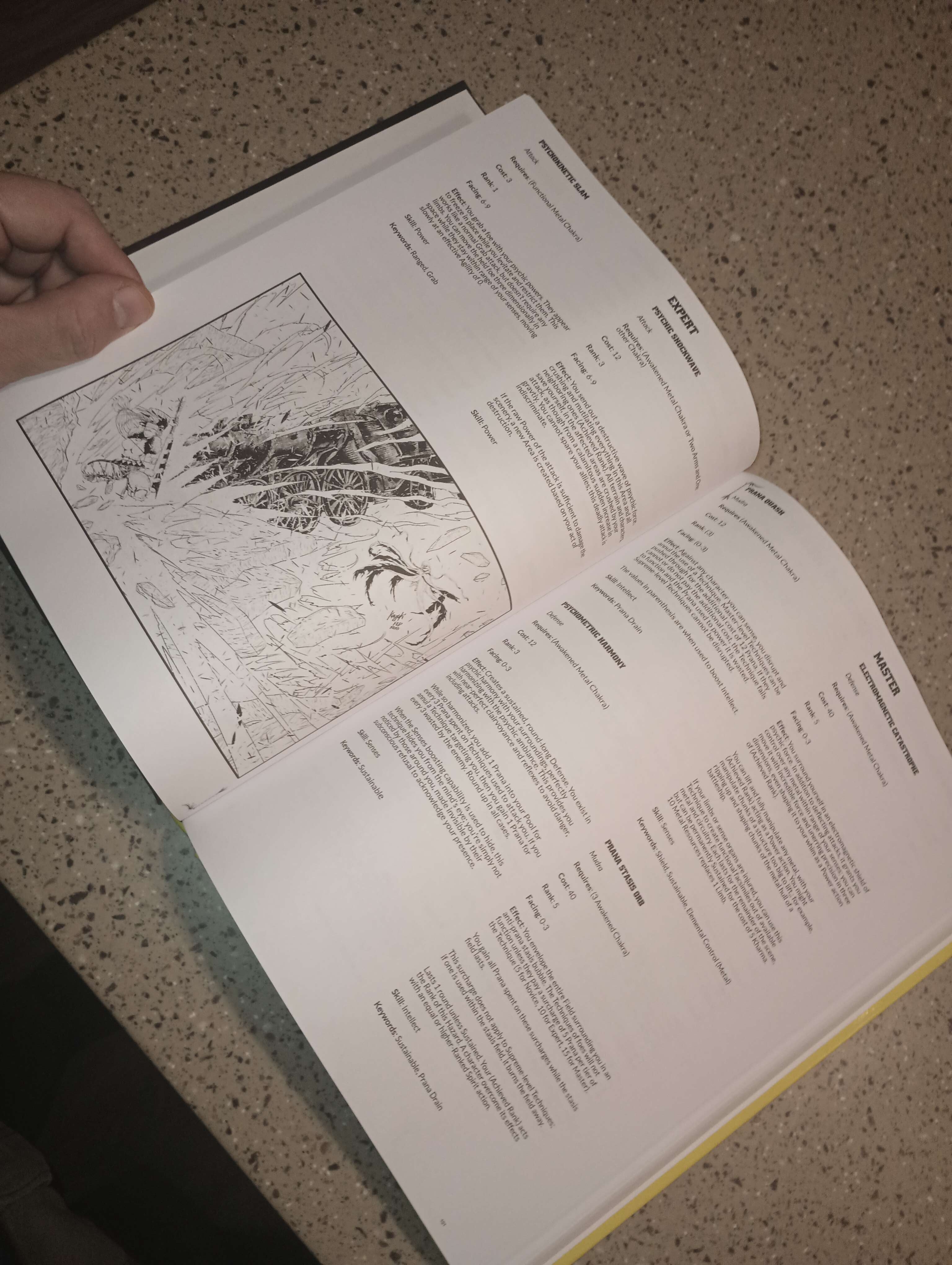
Oh how did an image of this book get here


This gives players the experience of being bulls in the China shop of the world. They're not just breaking things, they're breaking old, valuable things


I think it contributes to the player-versus-gm energy of the entire enterprise


If you're the kind of person who both deigns to run Exalted AND wants to keep their setting books as reference material, you're incentivized to sabotage the player's attempts to change established setting


Meanwhile, in what I can only describe as anticipatory design, the powers that players get explicitly outline ways in which the GM cannot fuck with them


Players have (and motherfucker, you better believe *I have*) pointed to the rules when the GM says some version of "no" to one of their hair-brained schemes and stated "that is exactly how this rule works, fuck you”


Nice try bitch, I'm a Solar

For example, good ol' husband-seducing demon dance


"I make a speech and get this whole village, who hate us, to march on that dragon blood blood camp". GM either sets the difficulty, or, more reasonable, scoffs at the notion and says "you can't do that".


You point to the charm:


Some relevant aspects: Characters with Mental DV less than the Solar’s successes must spend two Willpower or fall instantly in love either with the Solar or something the Solar represents.

(For scale, most mental DVs are between 2-3. A Solar's successes from a typical Performance roll number around Five)


This love is a form of commitment (see p. 201). Targets can break the commitment naturally but they must spend one Willpower in each scene where they deliberately attempt to shake it off."

Again, to give you an idea, most mortals have around four Willpower max. And spending a Willpower to resist mental influence is described in the text as extremely unlikely and rare.


"Motherfucker, how many willpower these shit farmers got? Because they're about to be in love with the idea”


 …


Now, obviously, I didn't want to foster those kind of crossed-incentives. I wanted an attitude of collaboration and mutual respect between players and GM.


BUT those decisions mean that the extremely fun, punk energy that Exalted can generate is sacrificed. How can you buck an authority enforcing boring bullshit, when the authority is on your side and everything is explosively cool?


Pictured: the typical LWF GM (chad)

I feel like my path forward here is to advise GMs to make their bad guys absolute dickweeds


"I use Jagi-summoning Technique!"

We need to transfer that punk energy where it always should have been: within the framework of the game itself


"In Lone Wolf Fists, the evil NPC is your enemy

In Exalted, the evil NPC is sympathetic and secretly right, so the GM is your enemy"


Thursday, July 27, 2023

GNS is communist gobbledygook


Well, I tried really hard to read GNS theory and my impression is that it is pure gibberish. It can’t even describe the bedrock TTRPG experience as anything but “ …(A) halting and incoherent mix of Gamism and Simulationism”. I actually didn’t set out to condemn it, but I sincerely cannot think of a more damning condemnation of a ttrpg theory than that.


Let me illustrate just how wrongheaded the theory is;


Imagine that you’d never heard of roleplaying games and had no concept of even playing them like games at all. You come up with an idea for an activity, let’s call it “labyrinth explorer”, where you design a huge, elaborate labyrinthine world and its denizens, and your friends all take on the role of explorers creeping through it.


There aren’t any rules to speak of when you start; just a very fundamental “call and response” style play, where:

  1. You describe the surroundings to the players (based on your map and notes of the area)

  2. They each tell you what activity they’d like to engage in, and for how long

  3. You describe the outcomes of their activities

So you have this diceless, mechanicless experience with only a few concrete boundaries:

  1. The labyrinth and everything in it is “real”; you, as the narrator, deny yourself the capacity to edit anything you’ve written down during the game. You can edit things prior to play if they haven’t been encountered, but after they’re a part of play, they’re “concrete”

  2. The world of the labyrinth operates on generally the same physical and psychological principles as our own; you, as the narrator, and to a lesser extent your players, are all committed to upholding this integrity so that the world can be “explored” as genuinely as possible


As you continue to run sessions of labyrinth explorer for your friends, you find the desire for the unexpected creeping in. It feels somewhat arbitrary to say one explorer can succeed at a task while another fails, and there’s no real tension to a violent encounter, since you’re certain of its outcome unless the explorer’s tactics really surprise you.


So, you introduce a few simple randomizers. Roll a die and get over a target number sort of things, rock simple but satisfying because:

  1. They take the outcome of reasonably uncertain but possible actions out of your control, allowing the world to surprise both you and the explorers

  2. They create true tension and stakes, despite their simple framework


A simple extension of these principles leads you to devise what we would call “wandering monster charts” based on the untrackably complex movements of the denizens of the labyrinth. Now, the time spent performing tasks risks encounters with the roving inhabitants of the labyrinth, adding another exciting and tense element to exploration.


And so it goes, I’m certain you all see where I’m heading with this. You eventually evolve something very similar to our collectively well-known alliterative hobby, keeping the principles I outlined above intact.


This is, essentially, the most intuitive and reasonable way to develop a TTRPG, but I’m eyeballing the “simulationist” description on the current GNS page and, well…


“Controversy: is that third box really there?

It has rightly been asked whether Simulationism really exists, given that it consists mainly of Exploration. I suggest that Simulationism exists insofar as the effort and attention to Exploration may over-ride either Gamist or Narrativist priorities.”


“Does D&D exist?!” Apparently, that’s a sincere question that was asked by the author of this theory. He was proud enough about this to write it down and make it widely publicly available.


Conclusion: I’m not going to waste any further neurons on GNS theory and I suggest you don’t either. You can read it, in its entirety, at this link if you really want to swallow an ocean of brain poison, but I advise you to spend your time productively instead. The author’s skill at fundamental elements of argument, like definition, is so exasperatingly poor that I can’t even properly describe it. Just, I mean look at this passage, where he flails at, and ultimately totally fails to, define his own re-definiton of “Exploration”:


“Exploration and its child, Premise

The best term for the imagination in action, or perhaps for the attention given the imagined elements, is Exploration. Initially, it is an individual concern, although it will move into the social, communicative realm, and the commitment to imagine the listed elements becomes an issue of its own.


When a person perceives the listed elements together and considers Exploring them, he or she usually has a basic reaction of interest or disinterest, approval or disapproval, or desire to play or lack of such a desire. Let's assume a positive reaction; when it occurs, whatever prompted it is Premise, in its most basic form. To re-state, Premise is whatever a participant finds among the elements to sustain a continued interest in what might happen in a role-playing session. Premise, once established, instils the desire to keep that imaginative commitment going.”


Notice how, twice, he derails his explanation of exploration into the assumed, imagined psychology of the people involved? I underlined those, if you missed them. Absent from this definition?  A FUCKING DEFINITION


How someone could see something that fails this spectacularly and grant it even the most merciful of credence totally perplexes me. This fails basic reading comprehension rules, people, it isn’t written by a genius but an idiot who desperately wants to be perceived as smart.


Whatever telephone game passed for knowledge transmission in the early aughties internet has obfuscated the reality of this drivel to the point where EVERYONE and their mothers refers back to it. People: I take back what I said earlier. I urge you to read this, in its entirety, and earnestly compare it to your actual experience playing TTRPGs. It will reveal itself as nonsensical ramblings within minutes.


My fundamental point: this is so catastrophically incorrect that even taking it seriously enough to correct it is a fundamental error. This is, plainly put, utter nonsense


Thursday, July 6, 2023

Lone Wolf Fists: In HARDBACK POD

 Get stoked folks, our hardback print on demand is unleashed, on Drivethrurpg!

Enjoy some glory shots:

Yeah that's Markiplier in the background

THICC

I had to see how the train suplex worked out. God, it's glorious in print


What's on the horizon? New, updated Blood from God's Eye intro adventure, updated character sheets (editable if I can figure it out!), GM screen (maybe?!) and then...?


I guess you'll have to stay tuned to find out!

Tuesday, May 9, 2023

Talking about Games Winning Technique: Prana Pathway Inflammation

Had ourselves a little contest recently in a cropssover with the Talking About Games channel. He does good stuff, by the way; certainly including his stellar review of Lone Wolf Fists, but he talks about a lot of fine games and gaming philosophy.
Honestly thought he reviewed in the nude
THE CONTEST:


In words: "CONTEST! Write your unique, over the top, super-powered martial arts move in the comments section, with its proper, amazing name! Be creative, it could be anything, from kicks, to punching to grappling, etc., with extreme effects that you would normally only see in anime and manga. Remember that in this TTRPG, you are able to become a God, so there is almost no limit as to what you can do. 

The martial arts move that I like the most, is going to win a Tian Shang Lone Wolf Fists core rulebook in PDF format. The contest ends this Friday the 5th, at 6:00PM CST, and within two or three days, I will announce the winner. If the winner never reclaimes the prize within three days of announcing the winner, another winner will be selected. Good luck!"

Our winning entry was submitted by our true-blue Ronwise Gamgee!  And the text he submitted was as follows:

"The Prana Pathway Inflammation Technique.  With this precise pressure-point strike, you can inflame the pathways of your opponent's open chakras, causing them to constrict and cause a great deal of pain commensurate to the amount of prana the opponent has gathered (kind of like clogging up an artery that is jam-packed with blood cells).  This strike deals an additional amount of damage equal to the prana that the opponent has gathered, all while wracking them in terrible pain (similar to that shocking sensation you get when you hold in a sneeze, put persistent).  Should the subject willingly disperse their prana, they will alleviate the condition.  If the condition is roleplayed, the character suffers intermittent, momentary paralysis every couple of seconds or so.  If enacted mechanically, the target temporarily loses access to one focus slot and suffers a 1-die reduction to their Effort pool."


This is a nifty idea for a Technique; it does lots of stuff! I like the "deals more damage if you have more Prana" thing, especially; there's a neat contradiction there, because the guy you'd like to use it against (the guy with a ton of Prana) is best-equipped to prevent it.


It's also incredibly Fist of the North Star, which I mean come on. That's the whole reason I made this game.

After mulling it over, I came to the following:
  1. This Technique rests very comfortably at the Expert level. It's flashy and direct, and it works best when its accessible. The lower Kharma and Prana costs put it within range of most characters.
  2. Its too similar to Five Gateways not to be some kind of derivation. So this is a Technique that escaped the grip of the Five Stars and made its way out into the wider Jianghu.
  3. This is actually a Technique AND a special Imbalance.
So that lead me to the following design. Enjoy your Technique Ron!


Prana Pathway Inflammation

Expert-Level Technique

A variant of several Five Gateway Techniques, this infamous move somehow escaped the scrutiny of the Five Stars and traveled far beyond their borders. Many upstarts and false claimants to their legacy have trumpeted its mastery, although the true Five Stars would have known its disputed lineage. They would have been impressed, though.

Attack
Requires: (Arm, Awakened Chakra)
Cost: 12
Rank: 3
Facing: 6-9
Effect: You strike several key pressure points in a blur of rapid fist movements, unleashing a cascade of Pranic malfunction within the enemy's Prana Meridians. filling the
Prana meridians with destructive vibrations. Rather than damage, this strike creates Aggravation towards a Prana Inflammation Imbalance. If it deals Aggravation to a foe,
increase the amount by the amount of Prana currently held in the targets Prana Pool.
Skill: Agility

Prana Inflammation: Physical Imbalance
Dramatic: Your body seizes and contorts at the worst possible moments in a series of "Prana Hiccups"
The originator of this Imbalance chooses when you're paralyzed or otherwise lose muscular control from these convulsions, which allows them to amend any of your proposed actions ending in clumsy failure once per turn per Rank of the Imbalance.

Such descriptions can include attacks hitting nearby targets instead of their intended victim, dropping weapons or other held items, falling down in an uncoordinated mess, and other potentially catastrophic blunders.

This Imbalance poisons the well of your Prana; if your Prana Pool is ever reduced to 0, it is immediately cured, no matter its current Rank. This Imbalance can never cause you to die (but it can certainly make your wish you were dead; hiccups of the soul are exponentially more horrible than their mortal equivalent!). For the purposes of reducing your Prana Pool to 0, you may spend Prana for no game-effect (it cascades out of you in a display of pyrotechnics, but otherwise has no effect)


Tuesday, May 2, 2023

I don't want to tell or be told stories. I want to play games.

 Let's start this blog post right, by linking you to a much more competent blog by a much more capable creator. Read that article and then come on back and read this one, if you've got any time or energy left.

And maybe go buy and play Adios.

I don't have a rebuttal to anything the man said or did, but I do have a notion that his masterfully executed article percolated in my brain, and I wished to share it.

I genuinely do not have any interest in telling or playing stories. None. Zip. Zilch. I find the act of fiction writing unsatisfying and I find things like visual novels uninspiring. Mind, I've played a few, but in the ultimate judgment I find my interest in them is where I can actively direct them, change them, how I can monkey with them.... How, in other words, I can play them like a game.

And hence, this thesis-cum-title: I don't want to tell or be told stories. I want to play games.

Let me immediately back off a little; I do actually love stories. What I'm talking about is, when I go to engage with a game, if I get a story instead, I'm upset. I don't want my game to be a story; I want it to be a game.

As an intriguing corollary to this, if a story is in fact, a game (or even game-ish!) I adore it. I found this out whenever I started picking at the mind-puzzles laid out in the fiction of Jorge Borges, by the way, and even earlier in life when I came across a collection of choose-your-own adventure books in the local used book store. The fantastic conundrum of MAZE also stuck with me, although I'm pretty sure the author of that enigmatic toy was playing dirty.

Notion One: I like stories with almost no conflict, but whose toyetic nature allows me to treat them like a game

What sprung first to my mind here was The Library of Babel by Borges. We'd be hard-pressed to find anything resembling conflict in this story; you might consider the past-tense descriptions of people's struggles "dramatic", but you shouldn't; that's a historical account, there's nothing unknown about it, nothing hanging in the balance. The entire tale is told in past-tense, and the desires of its conveyor aren't really even present in the story, let alone central. It is about as close as a dry, historical account of a totally fictional place could possibly be.

And I adore it.

I love the concept that every book that could conceivably ever be written must inevitably exist somewhere within the library, as well as the opposite of that book. By extension, anything which could be conceived and conveyed in English characters must exist, in nearly infinite forms, somewhere in its nigh-limitless (but still tantalizingly finite!) passages. I like that you can, right now, read a page from this mind-twistingly titanic library. Go ahead. Perhaps it will tell the legend of you, perfectly justifying and glorifying every facet of you.

If you followed my instructions and read that fantastic article I linked at the start of this journey, you'll immediately notice the friction between its mentally succulent points and the statements I just made. The Library of Babel is, in effect, not a story in so much as its a brief but dense and enormously interesting lore dump. It barely has characters, has zero plot and about as much drama as a math textbook.

But the universe it describes is going to live in me forever. I can go back to its strange, nearly-empty-of-all-life hexes whenever I turn my thoughts back to the notion it conveys. And I have already dwelled in there for a long, satisfying time.

Why do I love this not-story, this dry recounting of a world and a notion that doesn't and cannot exist? I think its because the concept is toyetic; it is something I can play with in my mind, a chewtoy for my imagination. I find its haunting possibilities seeping into my creative works, my games, even my everyday thought processes.

I don't feel it lacks anything; character drama would get in the way of the toy. Distract from the eerie purity of the idea.

For a less pure version of this notion, Tlön, Uqbar, Orbis Tertius (also by Borges) does actually start with something of a plot, but its ultimately consumed by the ideas (as is the world of the tale, but I'm getting ahead of us). Its a mystery, at first; why does Tlön appear in one encyclopedia, but not another? Is it real, or a fiction of some kind? And our author's self-insert certainly does experience friction and setbacks in trying to satisfying his intellectual curiosity in this matter.

But the more interesting notion, the superior toy, emerges and devours that scant narrative. And that idea is this; is there a meaningful distinction between Tlön being "real" or "fiction"?

It sends us into a spiral of embattled Dualism that ultimately makes a mockery of any concept of story and relapses back, like Library, into simply recounting this idea expanding and morphing its setting, distorting its lore around itself like a battleship displacing water to cut across the sea.

The hrönir, by the way, are one of the most toyetic ideas I've ever encountered. They've found their way, in one form or another, into almost every game I've ever ran.

Notion two: If in playing a game, I realize that it is not a game but a story, I feel cheated

The Stanley Parable jumps out as an example here; it goes so far as to make its single game-esque senquence, the "save the baby from X" sequence, an agonizing chore to mock your desire to play a game. A better example is Adios, of course, which is a story told via the medium of a game; it doesn't mock you so much as entirely forgo the notion that you're playing a game.

I hate that. I hate it like an unskippable cut scene before a boss fight. I hate it like an invisible wall that forces me to do some stupid task before I get to play more of the game I paid for. I hate it more than screen after screen of boring, pointless text that I have to mash X to get through and god help you if you accidently hit it once to much and select "Yeah repeat all that boring bullshit again please, waste my precious fucking time you stupid hooting asshole"

FUCK YOU

The problem with this notion is that I struggle to tell you, in essence, what is distinct between a game and a story, in the same way I can't tell you what's ontologically distinct between a sandwich and two slices of bread and a slice of ham thrown onto the floor. One is recognizably and intuitively a food, and the other is a mess.

Its something of a spectrum, I suppose; I don't mind a bit of story in my game. But I can dispense with story entirely and still enjoy a game (checkers, anyone?), and the more story that you put in my game, the more frustrated I become with the experience. 

This is about my limit

Whenever the story consumes the game, it can fuck right off; its just wearing my beloved game as a skinsuit at that point. Just be a book or a movie or whatever. Stop lying to me.

I think something of a litmus test is this; can I fuck with the ending? Can I depart from the intended experience while remaining within the bounds of the game (ie; no hacking the code or whatever)? The more you can honestly answer yes, the more I'll enjoy it.

The point: I need to follow this instinct when I run and write games

What's all this building to? That I shouldn't forget this instinct whenever I'm writing or running games.

One of the powerfully distinguishing factors between a game and a story is that one is allowed to become bored with a game. Stories should rightfully be criticized if they bore us, but a game isn't like that; a game can still be satisfying whenever its boring. 

I can't count the number of times whenever the player choice in one of my home games has resulted in them going somewhere that there is no further content to be mined; the dungeon is empty, there are no more clues at the Whately Mansion, etc. 

The temptation to roll the encounter dice or have something happen there can be overwhelming in these instances. The players have found an actual dead end; or, if I've properly Jaquaysed the map, they're found a closed loop without any fresh content.

If I were an author, and writing this as a story, I would (and should!) absolutely follow my instinct and put something here. It would be my actual job to do so; if this bit of tedium didn't somehow serve to further the plot, increase the drama, or enhance the mood, and EVEN THEN, it should almost certainly be ruthlessly cut.

But, whenever I play a game, I sometimes perform this exact kind of behavior. And it does actually waste my time. And I would be furious if the game decided to condescend to me by making my choice to make this mistake impossible. Like if there was a pop-up where some dickhead NPC said "Why don't you continue to the castle" or such, I would despise that. And I would be insulted to the point of quitting the entire experience if it simply teleported me to the fucking castle instead of letting me dick around in peace.

Yet that's exactly what I'm doing when I force content into these lulls. I'm breaking my own rules to deliver some preconceived outcome to players. Even when that outcome is just "something exciting happens!"

Same with scenes that "must" happen in a module, either because it's critical to forward momentum or because "it would be the coolest thing that could happen"

The coolest thing would be your players having real agency over their own destiny.

Giving myself advice here: Skip the "cool" boss fight, kill your darlings, let them make mistakes and get bored. If you truly must have someone kick down the door with a gun, lean on an encounter chart so you don't know when the door gets kicked down or who's kicking it down.

Because you'll have more game than story then. And as we've discussed, that's what both you and the players want.


Friday, April 28, 2023

Going full blog mode: observations from two Discord rants

One of the brilliant, witty, and no doubt handsome members of the Fistoverse had an observation about Shadowrun to share with the Discord:

"Shadowrun's set up for lots of good stories, but is a real ballache to run"
 
And as is typical when a comment catches my eye, I couldn't shut up for a for minutes. I share my bloviation with you all, for what scrapes of insight it possesses:


"Speaking as an elfgame maker; it is SUPER hard to get the broth right

Like you want everything to be this efficient little clock, but anytime you put two systems near each other they flip out start devouring each other like those Japanese fighting fish

God help you if you want to have an elegant core system AND distinguish weapon types AND have tactically meaningful combat. There's a reason most armory style supplements are just walls of minute variations of a handful of weapon types

So I feel for the system crafters. It's easy to fuck up and near impossible to get right

God DAMMIT that was more fun and elegant than anything I just spent four hours writing"
 

But our insightful and gorgeous Discordian had further observations, which enticed me to continue this particular tyrade:

"Main books need to be an evocative treatise on the setting and feel, on top of being a functional technical document

The eternal tragedy of the hobby is that TTRPG's don't make enough money to fund the extended playtesting that most need"

 
To which, I blunderingly replied:

"More than that; conceptually, there's a disconnect between what we would expect to be strategically viable in a fantastic universe versus what is ACTUALLY strategically viable in a fantastic universe

So you have games like Exalted where what we want, aka anime hero big sword magic blade beam, is markedly less viable than "guy who picked up the crimson bow and can kill you from another dimension"

The reality is that, as a designer, you're NEVER certain if a new option ruins the anticipated setting. That's the tactical infinity for you; man cannot stand against the infinite

So you have a disconnect between option-hungry players, and designers who only have a small library of options they're more or less certain result in the game as they sold it

My solution was to make the setting an inconstant nightmare, so you can't possibly make that worse by discovering where the setting breaks because too late, bitch! Already broken!

But you'll note, that IS a copout

I can't hope to run a test on every permutations of every idea I have, in every likely circumstance that I could anticipate (which would, at any rate, be only the barest fraction of what it would actually be exposed to in real world play)

So designers are left with, at best, a remarkably robust core and the hope that their latest wiggle from the mean isn't one deviation too far

That's just the nature of the beast

Wow I am in blog mode today what the hell"

Blog mode indeed, past Joel. Blog. Mode. Indeed.